Autism Spectrum in Adults: Information, Action Tips & Help
Why autistic traits in adults -- especially when well-masked -- are often recognized only late.
Late Diagnoses Are Common
Many autistic adults aren't diagnosed until decades in -- often after learning to mask their traits in social situations so successfully that people around them notice nothing. This is especially common for women and for people whose environment didn't recognize autistic traits because they didn't fit the usual picture.
The Cost of Masking
Masking can help you get through daily life in the short term, but it's associated with higher rates of exhaustion, anxiety, and depression -- it costs mental energy on an ongoing basis that's then missing elsewhere. Understanding your own behavior as an adaptation rather than a personal deficit is an important first step for many people.
Key point
Masking helps get through daily life short-term, but costs mental energy on an ongoing basis -- associated with more exhaustion, anxiety, and depression.
Related tests
Action tips
- Take your own need for withdrawal or reduced stimulation seriously, instead of suppressing it.
- Identify sensory triggers and adjust your environment where possible (headphones, lighting, clothing).
- Treat social energy as a limited resource -- deliberately schedule recovery time after interactions.
- Ask for clear, direct communication, instead of having to guess at implicit social rules.
- Seek out connection with other autistic people -- many report noticeable relief from peer contact.
Checklist: On the Way to an Autism Evaluation
- Took the RAADS-R and noted the result
- Gathered examples from childhood (your own memories, accounts from family)
- Talked to someone you trust about it
- Looked into a provider specializing in autism evaluation
- Thought about which everyday adjustments might already help
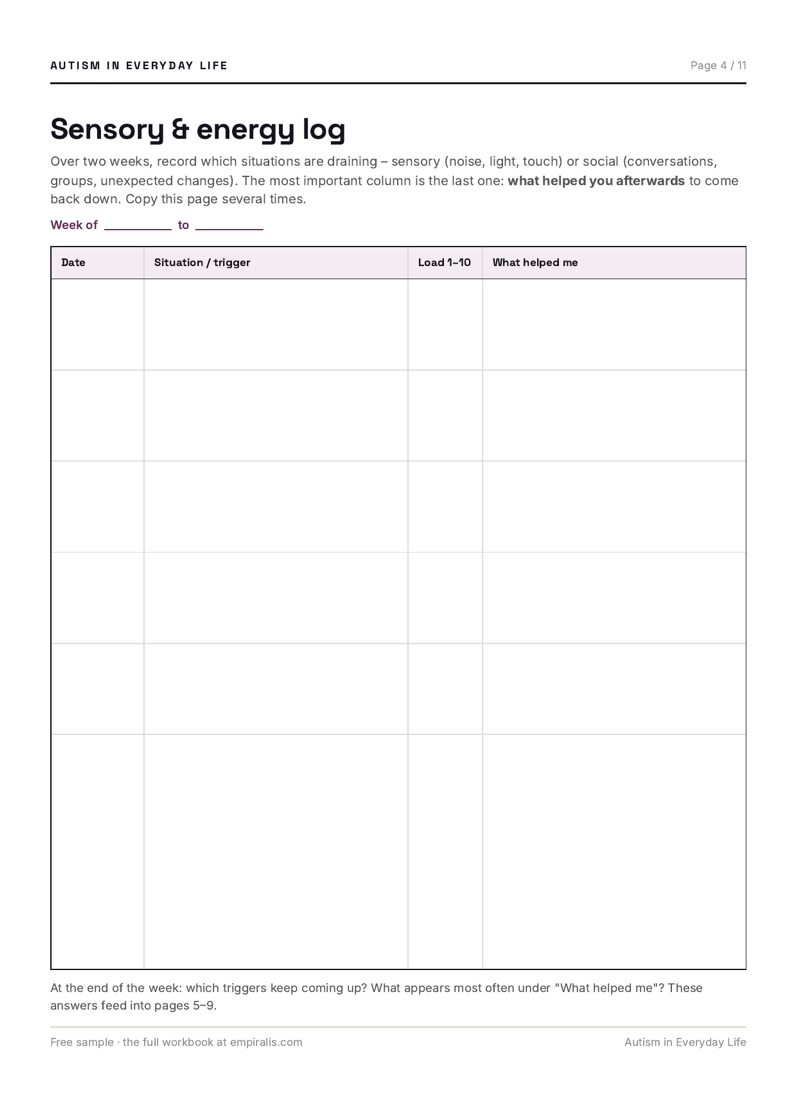
Sensory and Energy Log
Note situations with high sensory or social load -- this makes your own patterns visible and is helpful in an evaluation.
| Date | Situation | Load (1-10) | What helped |
|---|---|---|---|
What now?
The concrete next step: the real path to a diagnosis, contact points online and in person, and which of our worksheets fit where.
Help resources
Primary care doctor
A good first stop for a referral to further evaluation.
locally
Autistic Self Advocacy Network (ASAN)
An autistic-led nonprofit with information and peer community.
autisticadvocacy.org