Autism Spectrum: The Path to Diagnosis
The RAADS-R gave you a first signal -- but what's the actual next step? The full path: finding a provider, real contact points online and locally, what the diagnostic process looks like, and our workbook for the often-long wait in between.
Maybe you filled out the RAADS-R because so much of what feels automatic for other people has felt different for you your whole life -- and you've only recently started looking for an explanation that's more than "just try harder." A concerning result often confirms a feeling that was already there.
An online screener like the RAADS-R can't make a diagnosis -- only a specialized clinical evaluation can. But a concerning result is a good reason to actually take the next step. That's what this page is: not another self-assessment, but the concrete path there -- how to find the right provider, what to expect once you're there, and what helps during the often-long wait.
The honest version up front: unlike depression or anxiety, an adult autism evaluation in the US takes more effort to arrange, and wait times run longer -- commonly 6 to 12 months, sometimes 18 months or more, and it typically costs $2,000-$6,000 out of pocket if not covered by insurance. That doesn't make the evaluation less worthwhile, but it's worth checking your coverage and reaching out early.
The Path to Diagnosis -- Step by Step
1. Primary care doctor or therapist
Start with your primary care doctor or a therapist you already see, and ask for a referral to a clinician who specializes in adult autism evaluation -- typically a psychologist, though some psychiatrists, developmental pediatricians, and neurologists also do this work.
2. Finding a provider
The Autism Society's directory (autismsociety.org) and Psychology Today's therapist finder, filtered for autism spectrum, both help locate specialists. Before booking, check with your insurance about coverage, and ask whether a telehealth evaluation is an option -- it can shorten the wait considerably at some centers.
3. The diagnostic process
A thorough evaluation combines a clinical interview, your developmental history, and standardized tools -- commonly the ADOS-2 (a structured observation of communication and social interaction, about 40-60 minutes) and, where possible, the ADI-R (a structured interview, often with a parent or family member, about your childhood). Additional testing, like an intelligence assessment, is sometimes included.
4. Results and next steps
The final conversation covers the results and, regardless of outcome, recommendations for what comes next: possible support services, therapy for co-occurring concerns like anxiety or burnout, and connections to peer community.
Resources Online
Autism Society
A national nonprofit with a services directory and local affiliates across the US.
autismsociety.org →Autistic Self Advocacy Network (ASAN)
An autistic-led nonprofit with information and peer community.
autisticadvocacy.org →Psychology Today Therapist Finder
Searchable directory of specialists, filterable by autism spectrum as a specialty, insurance, and location.
psychologytoday.com →Resources Locally
Local Autism Society affiliate
Find your regional chapter through the national directory for local services and support groups.
autismsociety.org →Primary care doctor
A good first stop for a referral to specialized evaluation.
locally
988 Suicide & Crisis Lifeline
Free, confidential, available 24/7. Call or text.
988
A Workbook for the Wait In Between
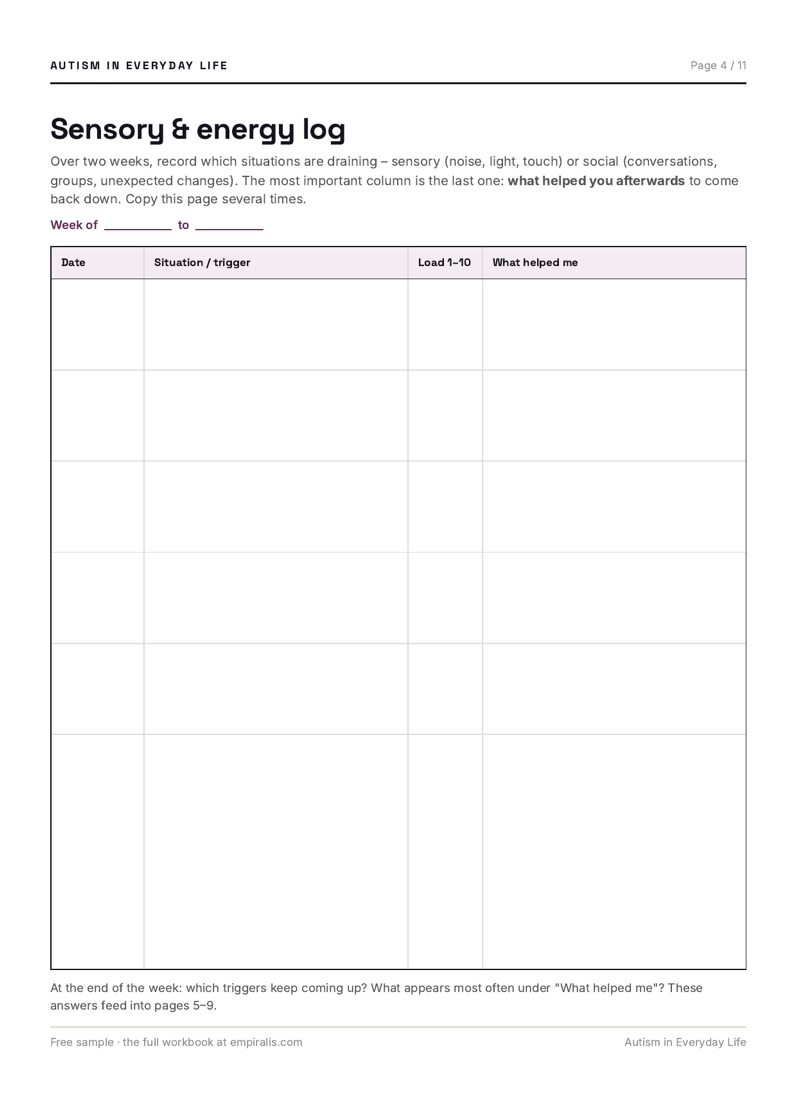
Between the first referral and the actual evaluation, there can be months of waiting. That time can be put to use: a workbook that helps regulate sensory load, budget social energy more deliberately, and prepare your own history for the evaluation.
More Tips for Daily Life
- Take your own need for withdrawal or reduced stimulation seriously, instead of suppressing it.
- Identify sensory triggers and adjust your environment where possible (headphones, lighting, clothing).
- Treat social energy as a limited resource -- deliberately schedule recovery time after interactions.
- Ask for clear, direct communication, instead of having to guess at implicit social rules.
- Seek out connection with other autistic people -- many report noticeable relief from peer contact.
- Use the wait actively: gather examples from childhood (your own memories, accounts from family, old report cards) -- this makes the developmental history part of the evaluation much easier.
Related on Empiralis