Practicing Self-Compassion: Information & Action Tips
What self-compassion actually means -- and why it's the opposite of self-pity or letting yourself off the hook.
What Self-Compassion Is -- and Isn't
Self-compassion is often confused with self-pity or a lack of discipline -- but it's actually the opposite. Researcher Kristin Neff describes three components: self-kindness instead of self-judgment, common humanity instead of isolation, and mindfulness instead of over-identifying with negative feelings.
Key point
Self-compassion is the opposite of self-pity: self-kindness, common humanity, and mindfulness instead of self-judgment and isolation.
Why It Works
Studies consistently link higher self-compassion to lower depression and anxiety and higher well-being. Contrary to worry, self-compassion doesn't lead to letting yourself off the hook -- if anything, the opposite: people who support themselves through setbacks instead of judging themselves tend to re-engage with challenges more readily.
Worksheet pack for this topic
Build Resilience
Build Resilience
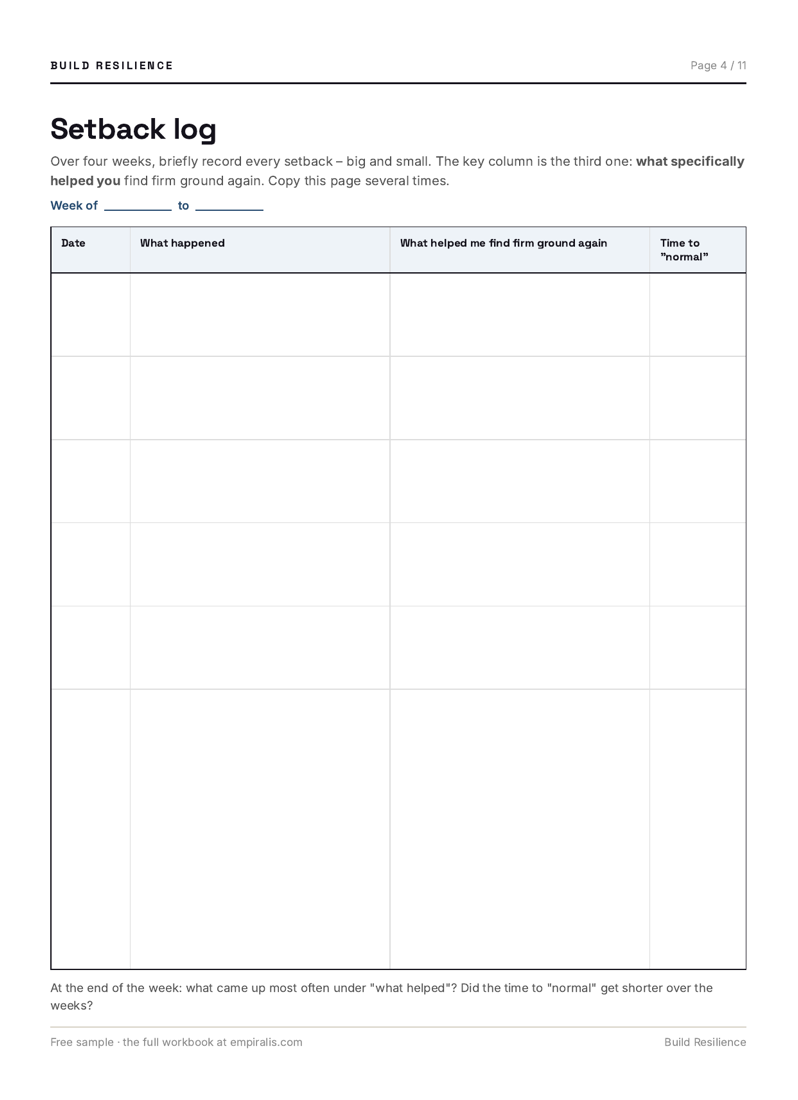
A workbook: resilience is not a fixed trait but how quickly you recover from setbacks – and that can be practised, over four weeks.
Related tests
Action tips
- When self-criticism shows up, pause and ask: "What would I say to a good friend in this situation?"
- Frame difficulties as part of shared human experience, not personal failure.
- Build in a brief self-compassion break: a hand on your heart, a few deep breaths, one kind sentence to yourself.
- Question perfectionistic standards -- they rarely protect against self-criticism, they usually intensify it.
Checklist: Practicing Self-Compassion
- Took the Self-Compassion Scale and noted the result
- Tried a self-compassion break
- Reworded one self-critical situation from the past week, as if for a good friend
Self-Compassion Journal
Note moments of self-criticism -- and what a more compassionate phrasing might look like.
| Date | Situation | Self-critical thought | More compassionate phrasing |
|---|---|---|---|