Build Resilience
A workbook: resilience is not a fixed trait but how quickly you recover from setbacks – and that can be practised, over four weeks.
€4.00 · 11 pages, A4, PDF
Buy on Ko-fi →Checkout and instant download via Ko-fi.
The Brief Resilience Scale does not measure the resources that support resilience (optimism, social support) but the outcome directly: how well you recover after setbacks. Resilience is not a fixed trait – how quickly we recover depends on circumstances, past experience and available support, and it changes. This workbook turns that into a four-week plan.
What's inside
- How to use the workbook – what the BRS measures and why resilience is changeable
- Baseline: BRS score, recovery signals and your usual duration
- Setback log: record over four weeks what happened and what helped
- Your coping strategies – what carried you through hard times before
- Thoughts after setbacks: for, against, a more realistic view
- The foundation: relationships, sleep and movement, meaning not just pleasantness
- Gentler with yourself – self-compassion in a crisis
- My emergency plan: the first 24 hours, the first week, when to get help
- Looking back after four weeks and sources
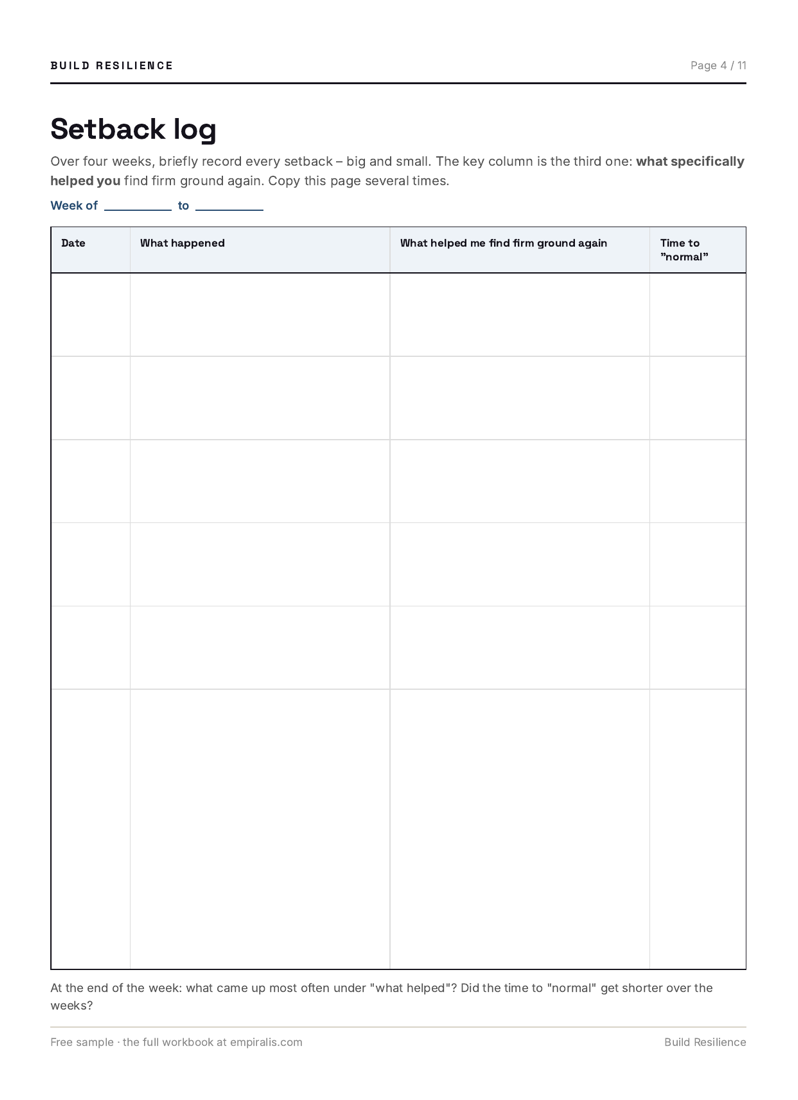
Free preview: Setback log (page 4)
Enter your email — we'll send a confirmation link. After confirming you go straight to the download. You'll also be subscribed to the Empiralis newsletter (unsubscribe any time).
Scientific basis
- Smith, B. W., Dalen, J., Wiggins, K., Tooley, E., Christopher, P., & Bernard, J. (2008). The brief resilience scale: assessing the ability to bounce back. International Journal of Behavioral Medicine, 15(3), 194–200.
Related on Empiralis