Child Development & Behavior: Information, Action Tips & Help
When parents worry about their child: how to make sense of what you're seeing and take the right first step.
When Parents Worry
Children's behavior fluctuates a lot -- depending on age, day-to-day mood, and circumstances like a move, a new sibling, or changes at home. Not every noticeable phase is cause for concern, but changes that persist over several weeks, or a clear divergence from peers, are worth taking seriously.
The First Step Matters More Than a Perfect Diagnosis
Parents don't need to make a diagnosis -- that's a professional's job. What helps more is gathering concrete observations and reaching out to your child's pediatrician early: early support generally works noticeably better than waiting it out.
Key point
Parents don't need to make a diagnosis -- concrete observations and an early conversation with your child's pediatrician help more.
Worksheet pack for this topic
ADHD in Children
ADHD in Children
A workbook for parents: gather concrete observations, ease everyday life and prepare well for a doctor's appointment.
Action tips
- Note concrete observations instead of a general impression -- this helps in a conversation with a professional.
- Actively seek feedback from daycare or school, not just your own perspective.
- Talk with your child about your observations in an age-appropriate way, instead of only talking about them.
- Consider behavior changes in context (e.g. a move, a new sibling, parents separating).
- Don't wait until it seems "too late" -- early support tends to work best.
Checklist: If You're Worried About Your Child's Development
- Took the PSC-17 and/or the Vanderbilt questionnaire
- Noted concrete observations from the past few weeks
- Gathered feedback from daycare or school
- Made an appointment with your child's pediatrician
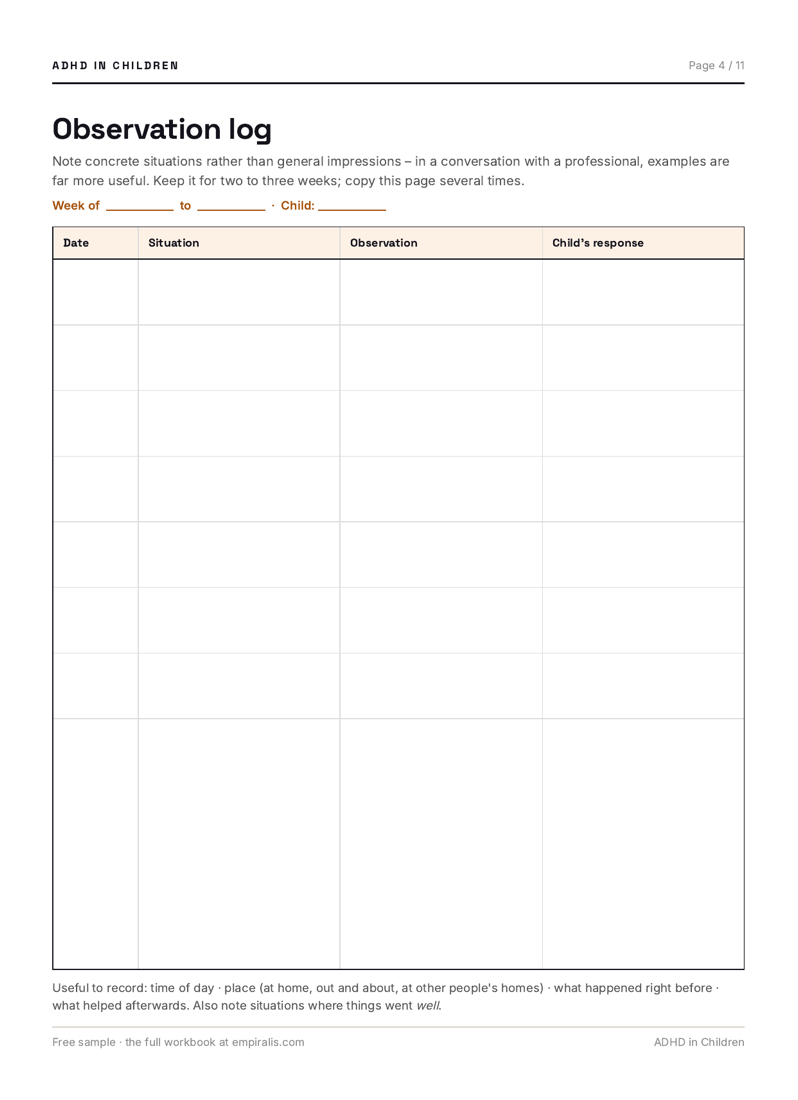
Observation Log
Note concrete situations rather than general impressions -- this is noticeably more helpful in a conversation with a professional.
| Date | Situation | Observation | Child's reaction |
|---|---|---|---|
What now?
The concrete next step: the real path to a diagnosis, contact points online and in person, and which of our worksheets fit where.
Help resources
Your child's pediatrician
A good first stop for evaluation and, if needed, a referral.
locally
National Parent & Youth Helpline
Free and confidential support, for both parents and kids.
1-855-427-2736