ADHD in Children: The Path to Diagnosis
The Vanderbilt parent questionnaire gave you a first signal -- but what's the actual next step? The full path: your child's pediatrician as the first stop, specialized resources online and locally, the multi-step diagnostic process, and our workbook for the time in between.
Maybe you filled out the Vanderbilt questionnaire because you've been worried about your child for a while -- daily life is more exhausting than it seems to be for other families, feedback from daycare or school keeps piling up, and you're wondering if there's more to it. A concerning result confirms that worry for now -- but it's a good reason to actually follow up on it.
A parent questionnaire like the Vanderbilt can't make a diagnosis on its own -- that takes a clinical evaluation that draws on more than one source. But a concerning result is a good reason to actually take the next step. That's what this page is: not another self-assessment, but the concrete path there -- who does what, how to find the right provider, what to expect once you're there, and what helps in the meantime.
Worth knowing up front: unlike some other conditions, ADHD in children is often diagnosed and managed directly by a pediatrician, per American Academy of Pediatrics guidelines -- not always requiring a specialist referral. And a solid evaluation never rests on one source alone: your observations as a parent matter, but so does feedback from daycare or school.
The Path to Diagnosis -- Step by Step
1. Your child's pediatrician
The first step is an appointment with your child's pediatrician -- bring your concrete observations, and ideally an impression from daycare or school too. Many pediatricians can evaluate and diagnose ADHD directly; for more complex cases, they may refer you to a child psychiatrist, developmental-behavioral pediatrician, or psychologist.
2. Getting the school's perspective
Because ADHD symptoms need to show up in more than one setting, a teacher or daycare provider filling out the Vanderbilt Teacher Rating Scale is a standard part of a thorough evaluation -- your pediatrician's office can usually provide that form for the school to complete.
3. The evaluation
A solid evaluation deliberately doesn't rely on one source: parent and teacher rating scales are combined with a clinical interview, behavioral observation, and often academic testing -- partly to rule out other explanations, like a child being under- or over-challenged at school.
4. Results and a treatment plan
The results are discussed together with a personalized plan. Guidelines recommend a multimodal approach: parent training in behavior management, possible school accommodations (a 504 plan or IEP), and, for more significant impairment, medication that's closely monitored medically.
Resources Online
CHADD (Children and Adults with ADHD)
A national nonprofit with a professional directory, parent resources, and local chapters.
chadd.org →Understood.org
Practical guides for parents on ADHD, 504 plans, and IEPs, including templates and sample plans.
understood.org →Resources Locally
CHADD National Resource Center
Phone support for finding local ADHD resources, Monday-Friday, 1-5pm ET (Spanish available).
1-866-200-8098
National Parent & Youth Helpline
Free and confidential, 24/7 support for parents.
1-855-427-2736
Your child's pediatrician
The first stop for evaluation and, if needed, a referral to specialized diagnostics.
locally
A Workbook for the Time In Between
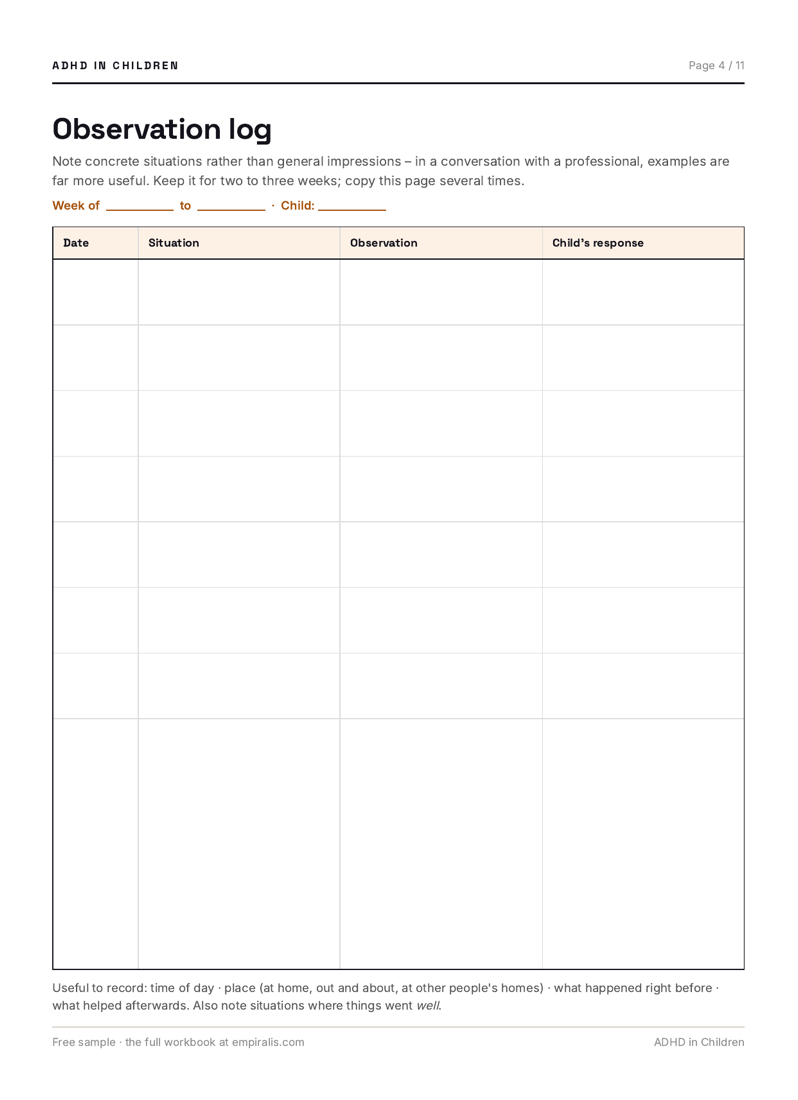
There's often time between a first concern and the actual evaluation. That time can be put to use: a workbook for parents that helps gather concrete observations in a structured way, ease everyday life, and prepare well for the pediatrician's appointment.
More Tips for Daily Life
- Note concrete observations instead of a general impression -- this helps in a conversation with a professional.
- Actively seek feedback from daycare or school, not just your own perspective.
- Give fixed routines and clear, short instructions -- this helps when structure is hard to maintain internally.
- Praise positive behavior specifically and often, instead of focusing only on what goes wrong.
- Build in regular movement breaks throughout the day.
- Don't wait until it seems "too late" -- early support generally works noticeably better than waiting.
Related on Empiralis