NICHQ Vanderbilt Assessment Scale – Parent Informant (ADHD)
Scientific background →This questionnaire is filled out by a parent about the child's behavior over the last 6 months. Alongside inattention and hyperactivity/impulsivity, it also covers three common co-occurring areas (oppositional behavior, conduct concerns, anxiety/depression) plus impairment in school, family, and social relationships. It's meant as a starting point for a conversation with a pediatrician -- not as a standalone diagnostic tool.
Comparison basis: 🇺🇸 US general-population sample · Cut-off from the validation literature
Ready to start?
55 statements · ~14 min
Important for interpretation
In the original instrument, a symptom domain (e.g. inattention or hyperactivity) is only considered clinically significant if the Performance/Impairment domain is ALSO elevated -- meaning at least one performance item was rated "Somewhat of a Problem" or "Problematic." Symptom frequency alone isn't considered sufficient in the original procedure. So always look at the impairment domain together with the others before interpreting them.
What this test is based on
- Questions
- 55
- Minutes
- ca. 14
- Answer scale (steps)
- 0–3
- Dimensions
- 6
The Vanderbilt scales were developed by Mark Wolraich and colleagues based on DSM-IV criteria and validated in a large sample of referred children (Wolraich et al., 2003). They're among the most widely used ADHD screening instruments in U.S. pediatric primary care.
What it measures
Inattention
9 items on inattention symptoms (criterion: 6 of 9).
Hyperactivity/Impulsivity
9 items on hyperactivity and impulsivity symptoms (criterion: 6 of 9).
Oppositional Defiant
8 items on oppositional, defiant behavior (criterion: 4 of 8).
Conduct
14 items on aggressive or rule-breaking behavior (criterion: 3 of 14).
Anxiety/Depression
7 items on anxious or low mood (criterion: 3 of 7).
Performance (School, Family, Social)
8 performance items on school, family, and social relationships. In the original procedure, at least one of these must be elevated for a symptom domain to count as clinically relevant.
Original source
- Wolraich, M. L., Lambert, W., Doffing, M. A., Bickman, L., Simmons, T., & Worley, K. (2003). Psychometric properties of the Vanderbilt ADHD diagnostic parent rating scale in a referred population. Journal of Pediatric Psychology, 28(8), 559–567. Open source →
Was this useful?
Empiralis stays free. If you'd like to support it, every bit helps keep it independent.
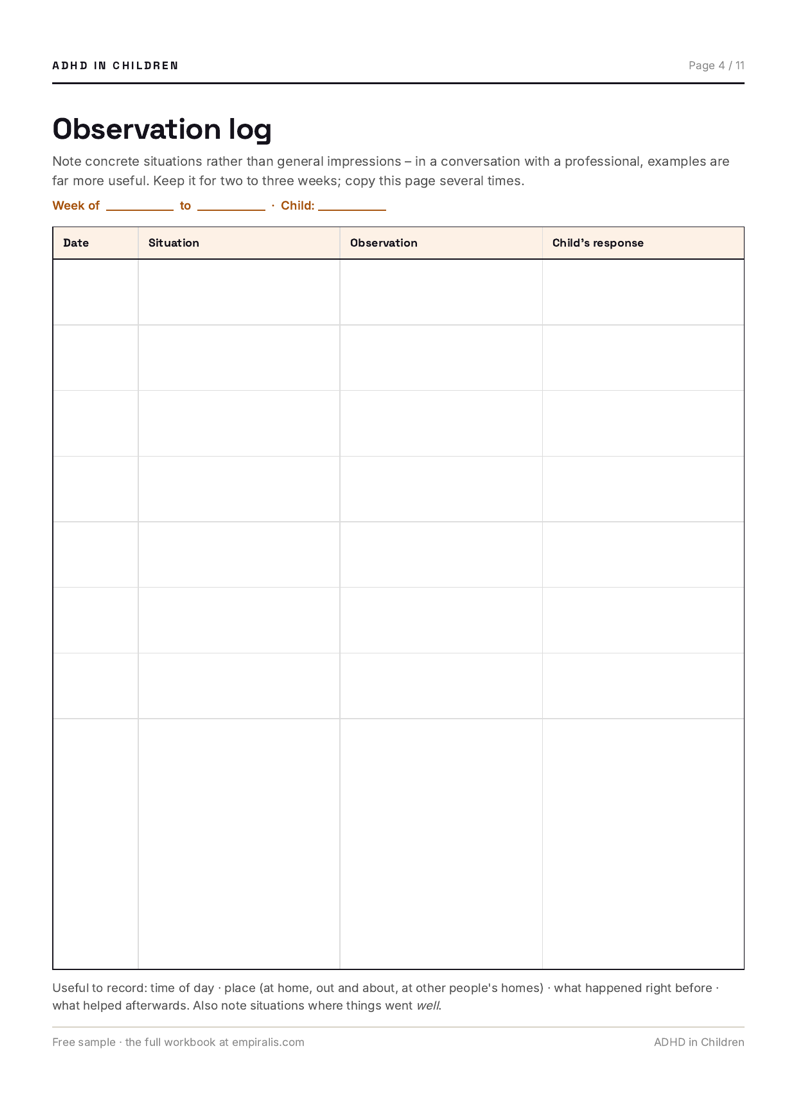
Worksheet pack for this topic
Want to go deeper?
This test is one signal among several. A guided path combines it with a few others instead of a single score.
What now?
The concrete next step: the real path to a diagnosis, contact points online and in person, and which of our worksheets fit where.