Anxiety & Anxiety Disorders: Information, Action Tips & Help
Where normal worry ends and a treatable anxiety disorder begins -- and what research shows genuinely helps.
Where Normal Worry Ends
Worry and nervousness are a normal part of life -- they only become a clinical concern when they're disproportionately frequent, intense, or hard to control, and noticeably limit everyday life. Generalized anxiety disorder shows up as persistent tension spanning many areas of life, often alongside restlessness, muscle tension, sleep problems, or a sense that "something bad" might happen.
What Research Says About Effective Help
Anxiety disorders are among the most treatable mental health conditions. Cognitive behavioral therapy -- especially with exposure elements, where avoided situations are gradually approached again -- shows strong effectiveness. A key mechanism: avoidance relieves anxiety in the short term but reinforces it long-term, because the brain never gets the chance to learn that the feared situation is actually manageable.
Key point
Avoidance relieves anxiety short-term but reinforces it long-term -- cognitive behavioral therapy with exposure elements shows the strongest effectiveness.
Was this useful?
Empiralis stays free and ad-supported. If you'd like to support it directly instead, every bit helps keep it independent.
Related tests
Action tips
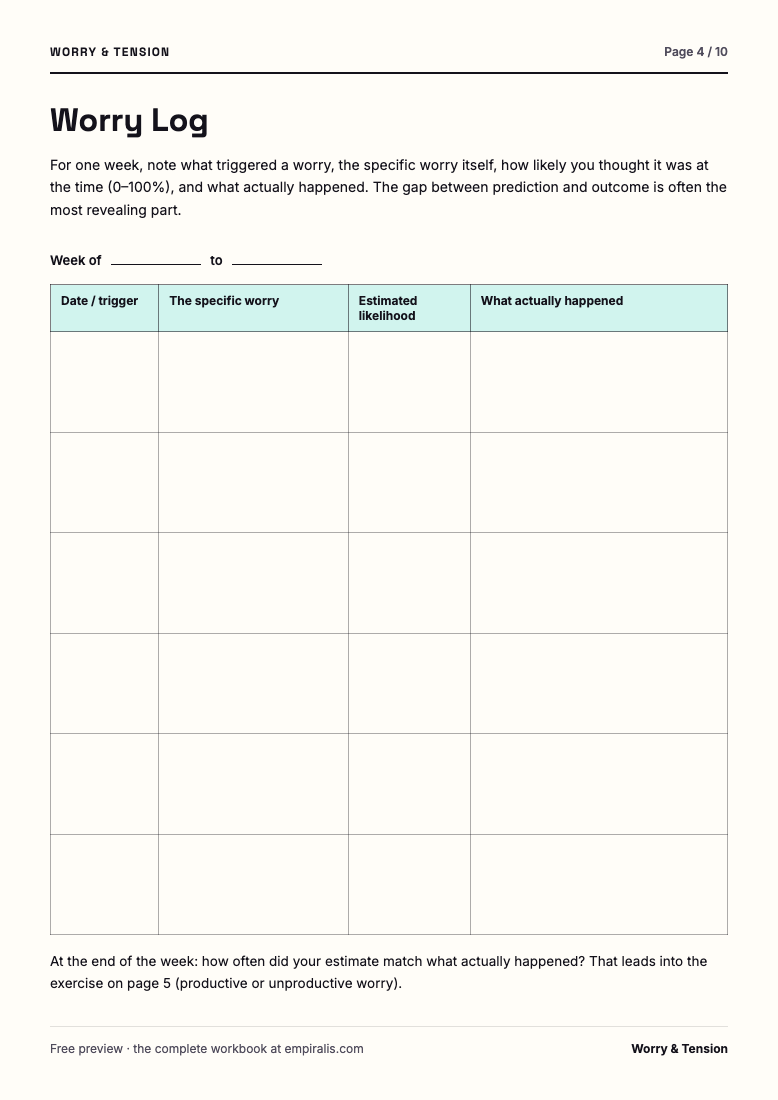
- Set a fixed "worry time": a limited window each day for rumination, instead of letting it run all day.
- Notice avoidance: short-term relief from avoiding something reinforces anxiety long-term -- small, doable steps toward the feared situation work better.
- Practice an extended exhale (e.g. breathe in for 4 seconds, out for 6) -- this activates the body's calming nervous system.
- Keep an eye on caffeine and alcohol intake, since both can worsen anxiety symptoms.
- Write down catastrophic thoughts and question them: "How likely is this, really? What speaks against it?"
- Schedule regular physical exercise -- it shows a measurable tension-reducing effect.
Checklist: Coping With Significant Anxiety
- Took the GAD-7 and noted the result
- Talked to someone you trust about it
- Made an appointment with a primary care doctor
- Tried a relaxation or breathing technique
- Looked into how to find a therapist (e.g. via SAMHSA's National Helpline)
- Kept going with daily life despite the anxiety, instead of avoiding situations entirely
Anxiety Log
Note the situations where anxiety shows up -- this helps you spot triggers and patterns that are valuable to discuss with a professional.
| Date/time | Trigger/situation | Anxiety (1-10) | Thought in the moment | What I did |
|---|---|---|---|---|
What now?
The concrete next step: the real path to a diagnosis, contact points online and in person, and which of our worksheets fit where.
Help resources
988 Suicide & Crisis Lifeline
Free, confidential, available 24/7. Call or text.
988
SAMHSA's National Helpline
Free, confidential referrals to local treatment and support services.
1-800-662-4357
Primary care doctor or therapist
A good first stop for evaluation, support, and referral.
locally