Anxiety: The Path to Treatment
The GAD-7 gave you a first signal -- but what's the actual next step? The full path: where to start, real contact points online and locally, what a first appointment looks like, and our workbook for the time in between.
Maybe you filled out the GAD-7 because the worry has gotten louder lately than you can steer -- the thought loop that doesn't stop at night, the tension that barely switches off anymore. A concerning result rarely feels like relief. But it's a good reason to actually change something now, instead of continuing to sit with it.
An online screener like the GAD-7 can't make a diagnosis -- only a thorough clinical evaluation can. But a concerning result is a good reason to actually take the next step. That's what this page is: not another self-assessment, but the concrete path there -- who does what, how to actually find a provider, what to expect once you're there, and what helps in the meantime.
The good news first: anxiety disorders are among the best-researched and most treatable mental health conditions. The US doesn't have one single, centralized path to treatment -- what you do next depends partly on whether you have insurance -- but there are real, working paths either way, and none of them require a referral just to start looking.
The Path to Treatment -- Step by Step
1. A primary care doctor, or go directly to a therapist
Most insurance plans don't require a referral for outpatient therapy -- you can generally contact a therapist directly. Seeing your primary care doctor first is also a valid path, especially to rule out physical causes of common anxiety symptoms (like thyroid or heart issues) that can feel very similar. Either way works; what matters is taking one of them.
2. Finding a provider
The ADAA's Find Your Therapist directory (findyourtherapist.adaa.org) is specifically focused on anxiety, depression, OCD, and PTSD specialists. Psychology Today's broader therapist finder (psychologytoday.com) also lets you filter by specialty, insurance, and sliding-scale availability. If cost is a barrier, a Federally Qualified Health Center offers therapy on a legally required sliding scale regardless of insurance status -- find one at findahealthcenter.hrsa.gov.
3. The first appointment
A first session is usually an intake evaluation: a longer conversation covering your symptoms, history, and current life situation. By the end, the provider will typically share their impression -- for example generalized anxiety disorder, panic disorder, or social anxiety -- and a recommendation for next steps.
4. Ongoing treatment and, if needed, medication
Cognitive behavioral therapy with exposure elements shows the strongest effectiveness for anxiety disorders. For more severe symptoms, medication can help alongside therapy -- your primary care doctor or a psychiatrist can discuss that with you.
Resources Online
ADAA Find Your Therapist
A directory of licensed therapists specializing in anxiety, depression, OCD, and PTSD.
findyourtherapist.adaa.org →ADAA Peer Support Groups
Free, anonymous, online peer-to-peer support groups for anxiety, depression, and PTSD.
adaa.org/find-help/support →Psychology Today Therapist Finder
A free, searchable directory of therapists, filterable by specialty, insurance, and sliding-scale availability.
psychologytoday.com →Resources Locally
988 Suicide & Crisis Lifeline
Free, confidential, available 24/7 -- also for support that isn't an acute emergency.
988
SAMHSA's National Helpline
Free, confidential referrals to local treatment facilities and support services.
1-800-662-4357
Federally Qualified Health Center
Therapy and primary care on a legally required sliding scale, regardless of insurance status. Find one via findahealthcenter.hrsa.gov.
locally
Primary care doctor or therapist
A direct local contact point -- no referral typically needed for outpatient therapy.
locally
A Workbook for the Time In Between
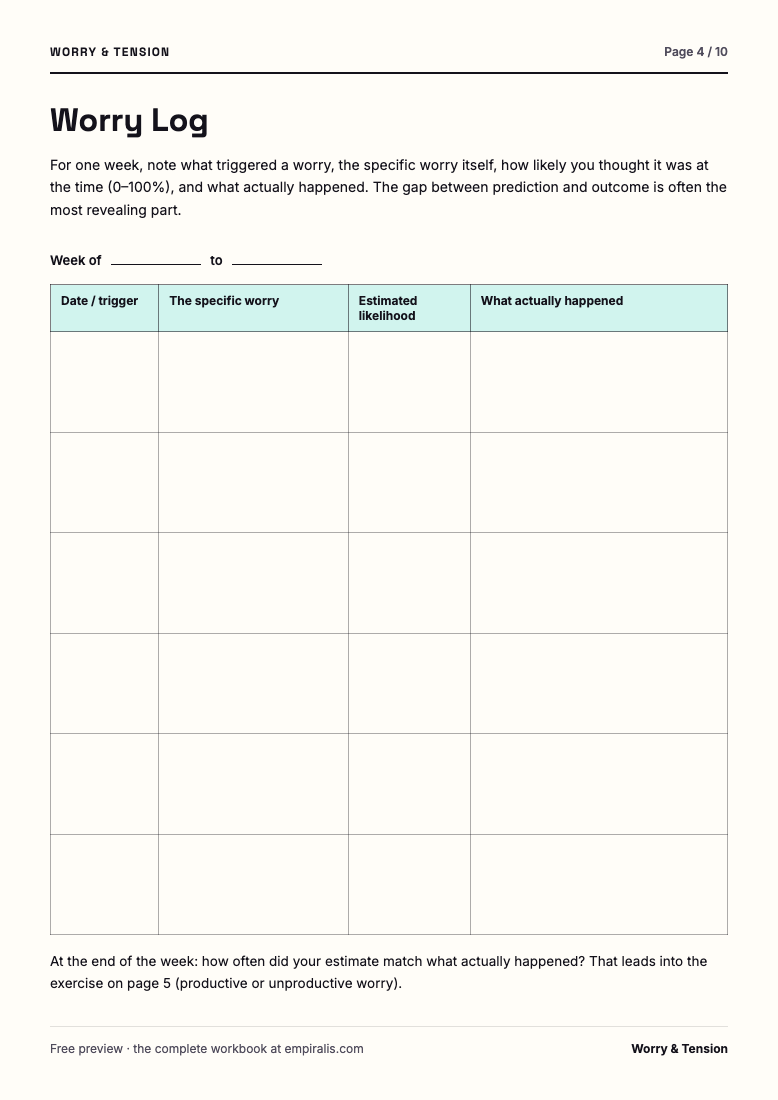
Weeks often pass between a first concern and an actual appointment. That time can be put to use: a structured workbook makes visible which worries are productive and which aren't, and helps gradually reduce early avoidance -- valuable for you, and for the conversation in your first session.
More Tips for Daily Life
- Set a fixed "worry time": a limited window each day for rumination, instead of letting it run all day.
- Notice avoidance: short-term relief from avoiding something reinforces anxiety long-term -- small, doable steps toward the feared situation work better.
- Practice an extended exhale (e.g. breathe in for 4 seconds, out for 6) -- this activates the body's calming nervous system.
- Keep an eye on caffeine and alcohol intake, since both can worsen anxiety symptoms.
- Write down catastrophic thoughts and question them: "How likely is this, really? What speaks against it?"
- Schedule regular physical exercise -- it shows a measurable tension-reducing effect.
Related on Empiralis