Worry & Tension
Worry & Tension
A calm workbook for the GAD-7: make your worries visible, tell productive worry from unproductive worry, set a fixed worry time, calm the body, and reduce avoidance -- over four weeks.
€4.00 · 10 pages, A4, PDF
Buy on Ko-fi →Checkout and instant download via Ko-fi.
The GAD-7 tracks how often seven core symptoms of generalized anxiety have shown up over the last two weeks -- from nervousness and not being able to switch off, to irritability and fearing something awful might happen. It's a screening tool, not a diagnosis. This workbook turns the result into four weeks of concrete work: noticing which worries actually show up, setting a fixed worry time instead of worrying all day, calming a body stuck in constant tension, and gradually reducing avoidance and reassurance-seeking. It doesn't replace therapy, but it can help you prepare for it or support it alongside.
What's inside
- How to use this workbook -- what the GAD-7 measures, how to read the thresholds, and when professional help makes sense
- Baseline: place your GAD-7 score and name the strongest of your seven symptoms
- Worry log: for one week, track the trigger, the specific worry, your estimated likelihood, and what actually happened
- Productive or unproductive worry: sort your worries with a decision tree -- a solvable problem right now, or hypothetical rumination
- Worry time: set a fixed daily time for worrying and postpone worries that show up outside it
- Calming the body: notice tension, try an extended exhale, and the 5-4-3-2-1 grounding exercise with a before/after log
- Avoidance and reassurance-seeking: notice what you avoid and how often you seek reassurance -- and deliberately do one thing differently this week
- Plan the week and look back: set small steps, review the journal, retake the GAD-7
- Notes and source
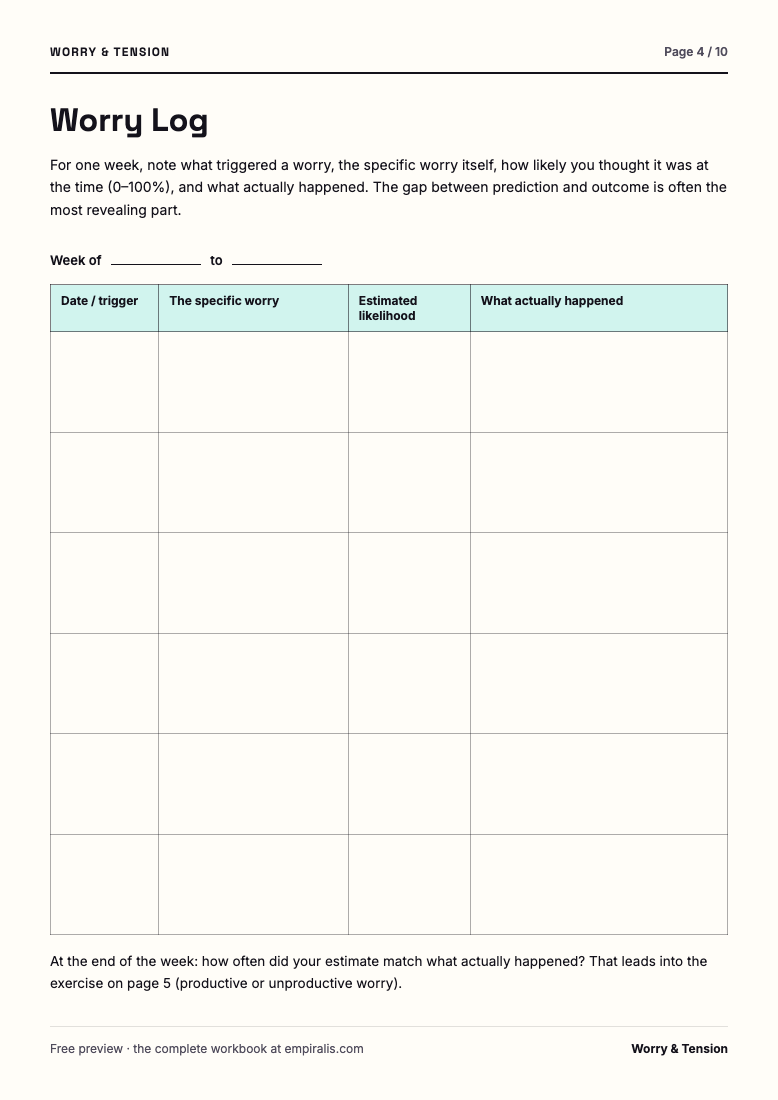
Free preview: Worry log (page 4)
Enter your email — we'll send you the download link. The first time, you'll confirm your address via a link first; if you're already subscribed, the download link comes straight away. Either way you're subscribed to the Empiralis newsletter (unsubscribe any time).
Scientific basis
- Spitzer, R. L., Kroenke, K., Williams, J. B. W., & Löwe, B. (2006). A brief measure for assessing generalized anxiety disorder: The GAD-7. Archives of Internal Medicine, 166(10), 1092–1097. — The GAD-7 is in the public domain and may be reproduced, translated, and used without permission. The 5/10/15 thresholds come from this validation study.
- National Institute for Health and Care Excellence (2011, updated 2020). Generalised anxiety disorder and panic disorder in adults: management (CG113). — Referenced as the basis for this workbook's exercises: a worry log, a fixed worry time (stimulus control), distinguishing productive from unproductive worry, and gradually reducing avoidance and reassurance-seeking are established elements of cognitive behavioral therapy for generalized anxiety. The exercises are adapted for self-guided use and don't replace therapy.
Related on Empiralis