The CBI measures burnout separately across three sources: personal exhaustion (independent of your job), work-related exhaustion, and -- if it applies to you -- exhaustion from working with clients, patients, students, or anyone else you support as part of your job. If you're currently not working or don't work with clients, answer those questions as best fits your situation -- those two subscales may be less informative for you.
Comparison basis: 🌍 Cross-national validation · Cut-off from the validation literature
Ready to start?
19 statements · ~6 min
What this test is based on
- Questions
- 19
- Minutes
- ca. 6
- Answer scale (steps)
- 0–100
- Dimensions
- 3
The CBI was developed in 2005 by Kristensen, Borritz, Villadsen, and Christensen as a freely available alternative to the commercial Maslach Burnout Inventory. It shows good internal consistency (Cronbach's alpha between .85 and .91) and correlates strongly with established burnout and exhaustion measures. The authors emphasize that burnout is not a stable personality trait but can change meaningfully over time -- retaking the test periodically can help make those changes visible.
The Personal Burnout subscale (items 1-6) is also discussed in the research literature as a possible screening signal for autistic burnout. The authors themselves published normative data in 2004 (Borritz & Kristensen, nfa.dk): the only clinical cutoff they publish is a score of 50 or more as "a high degree of burnout" (in the PUMA project's comparison sample of roughly 1,900 employees in social/care professions, 16-22% reached this level depending on the subscale).
The lower bound of the "average" range was additionally derived from the means/standard deviations reported there: Personal Burnout from a representative Danish population sample (N=1,498, M=32.7, SD=15.7), Work- and Client-related Burnout from the PUMA sample (Work: M=33.0, SD=17.7, N=1,910; Client: M=30.9, SD=17.6, N=1,752), since no general-population data exists for those two work-specific subscales.
What it measures
Personal Burnout
General physical and emotional exhaustion, independent of your working life.
Work-Related Burnout
Exhaustion specifically tied to your job.
Client-Related Burnout
Exhaustion from working with clients, patients, students, or others you support -- relevant if you work in a role like that.
Original source
- Kristensen, T. S., Borritz, M., Villadsen, E., & Christensen, K. B. (2005). The Copenhagen Burnout Inventory: A new tool for the assessment of burnout. Work & Stress, 19(3), 192–207.
- Borritz, M., & Kristensen, T. S. (2004). Copenhagen Burnout Inventory: Normative data from a representative Danish population and results from the PUMA study. National Institute of Occupational Health, Copenhagen. Open source →
Was this useful?
Empiralis stays free. If you'd like to support it, every bit helps keep it independent.
Worksheet pack for this topic
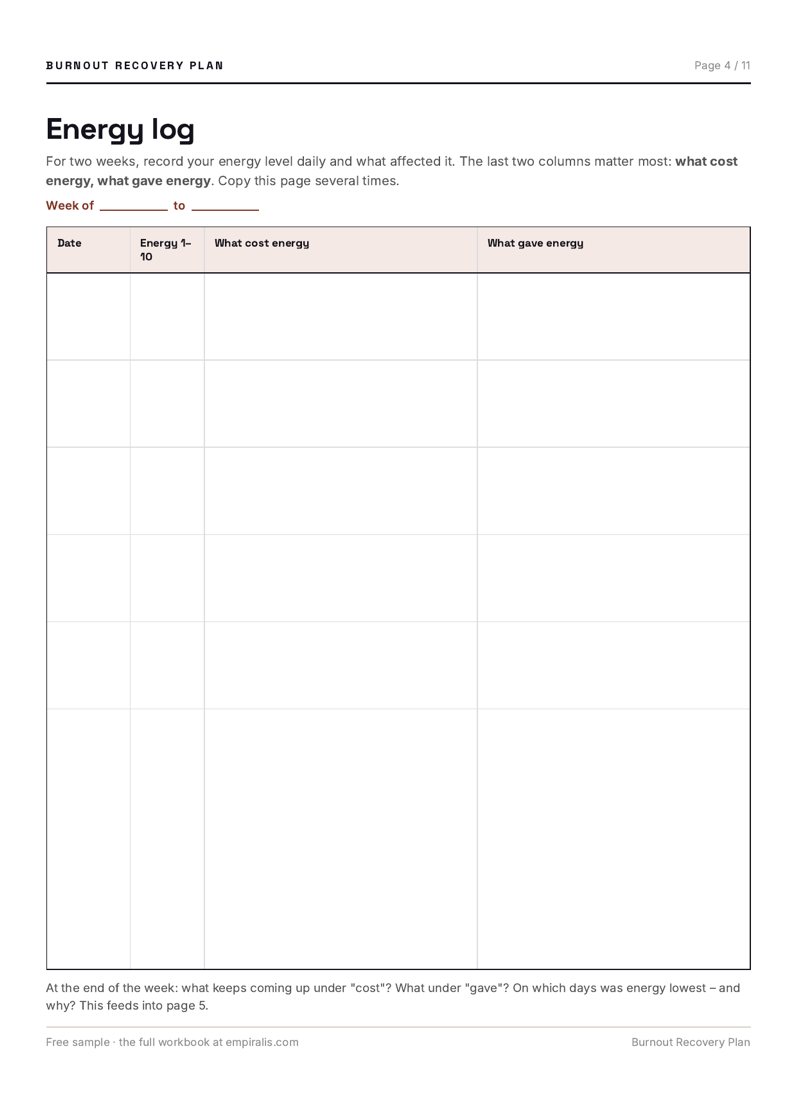
Want to go deeper?
This test is one signal among several. A guided path combines it with a few others instead of a single score.