Building Self-Esteem: Information & Action Tips
What self-esteem actually is, and why it's trainable -- despite what you might assume.
What Self-Esteem Actually Is
Global self-esteem describes how fundamentally satisfied someone is with themselves -- independent of individual successes or failures. Research links stable, positive self-esteem to better coping with setbacks; what matters most is that it doesn't depend on constant outside validation.
Self-Esteem Is Trainable
Contrary to common assumption, self-esteem isn't a fixed personality trait -- it can shift through deliberate practice, including consciously noticing your own successes and treating your own mistakes with more patience.
Worksheet pack for this topic
Building Self-Esteem
Building Self-Esteem
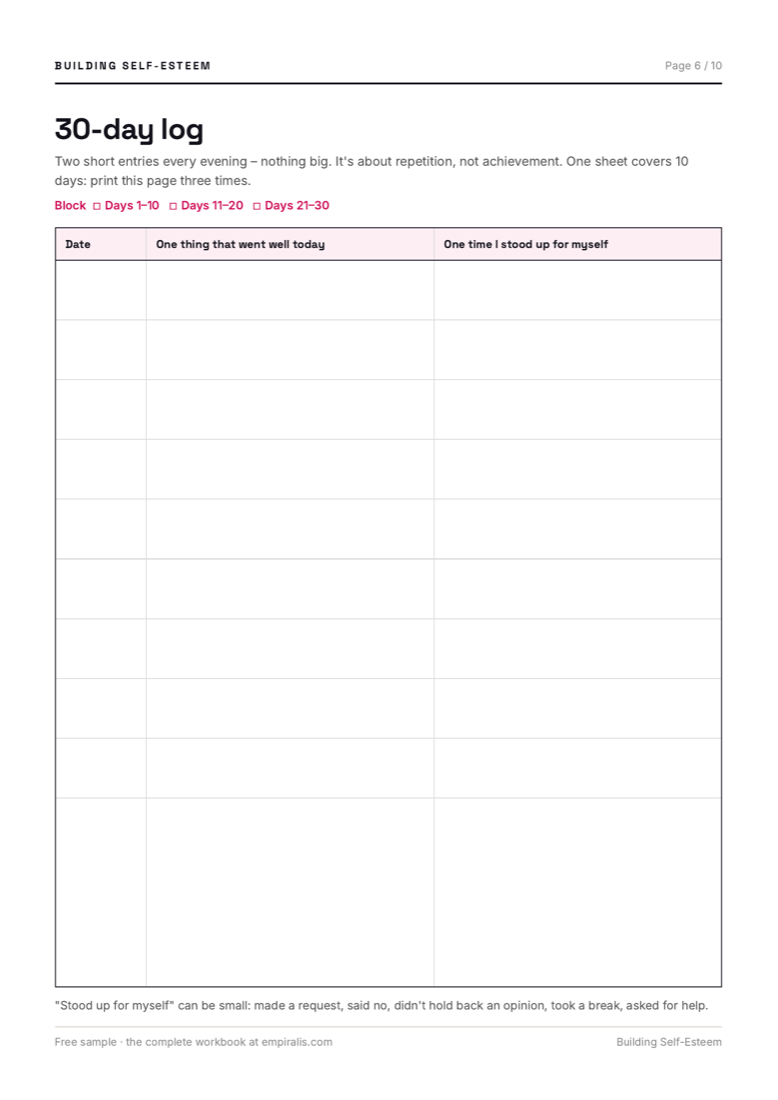
30-day workbook: self-esteem can be practised – above all by noticing your own successes and being gentler with your mistakes.
Related tests
Action tips
- Consciously notice your successes and credit them to yourself, instead of attributing them to luck or chance.
- Separate your inner critic from the facts: a mistake doesn't make you worthless.
- Deliberately cut back on comparisons with others -- especially on social media.
- Keep a short success journal to make your own progress visible.
- Treat yourself the way you'd treat a good friend.
Checklist: Building Self-Esteem
- Took the Rosenberg Self-Esteem Scale and noted the result
- Wrote down three of your own strengths
- Deliberately questioned one negative self-judgment from the past week
- Consciously acknowledged one small success from the past week
Success Journal
Each day, write down one small success or a positive quality you noticed in yourself.
| Date | Success/situation | What this shows about me |
|---|---|---|