Attachment Style & Relationships: Information, Action Tips & Help
How attachment patterns form, why they aren't a fixed fate, and what supports changing them.
Learned Protective Strategies, Not Character Flaws
Attachment anxiety and attachment avoidance aren't fixed personality traits -- they're patterns that developed early on in relationships with important caregivers, as a sensible adaptation to the circumstances at the time. In adulthood, though, those same patterns can lead to misunderstandings and conflict in romantic relationships that have little to do with the actual person in front of you.
Change Is Possible
Attachment research has a concept called "earned security": people with insecure attachment patterns can develop more secure patterns over time through corrective relationship experiences -- for example in a stable partnership or in psychotherapy.
Key point
"Earned security": insecure attachment patterns can change over time through corrective relationship experiences.
Worksheet pack for this topic
Understanding Your Attachment Style
Understanding Your Attachment Style
A workbook on attachment anxiety and attachment avoidance: spot your own patterns, say needs as a request rather than a reproach, repair after conflict – a companion to the ECR-R.
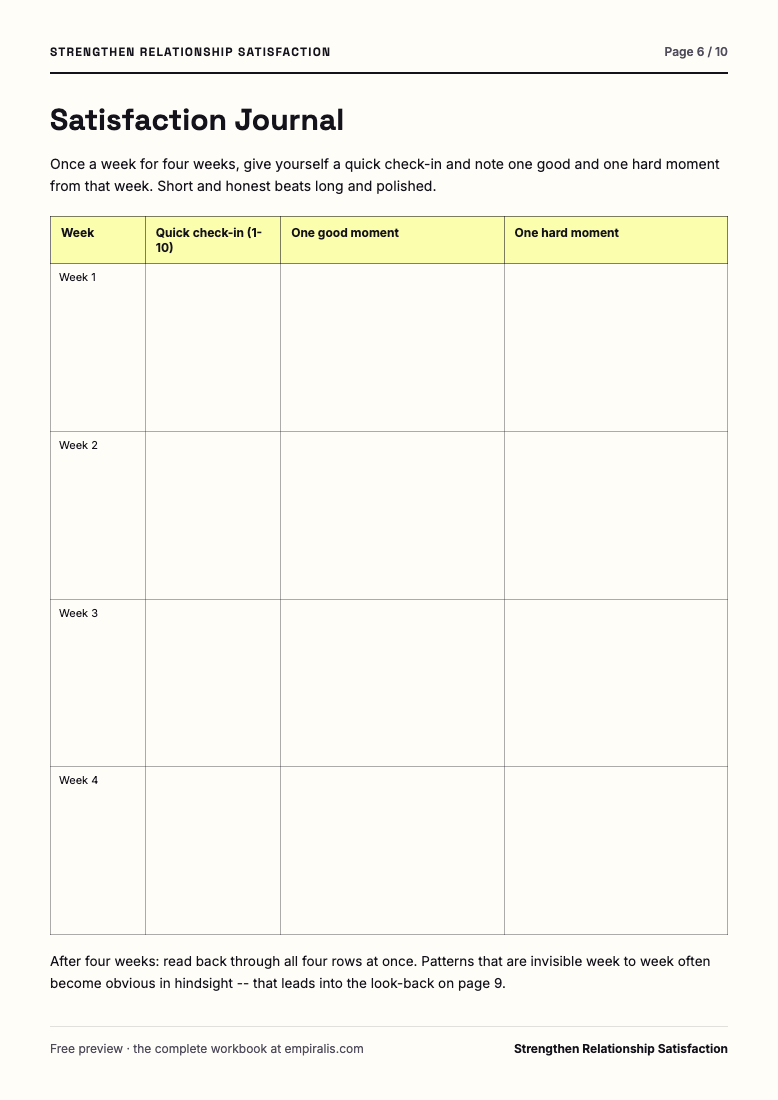
Strengthen Relationship Satisfaction
Strengthen Relationship Satisfaction
A workbook for the CSI-4: place your overall score, look underneath it at what's actually carrying it, turn a wish into a concrete request -- and stay with it for four weeks. For yourself alone, or as a conversation together.
Related tests
Action tips
- Name your own patterns instead of treating them as a personal failing -- they're learned protective strategies.
- Voice your needs openly, instead of hoping your partner will guess them.
- When fear of loss shows up, pause before seeking reassurance -- often just noticing the impulse already helps.
- If you tend toward avoidance, deliberately take small steps toward closeness, even if it feels uncomfortable at first.
- See conflict as a chance to clarify things, not as a threat to the relationship.
Checklist: Working on Your Own Attachment Style
- Took the ECR-R and noted the result
- Reflected on recurring patterns in past relationships
- Talked openly with your partner about your own needs
- Considered whether couples counseling might help
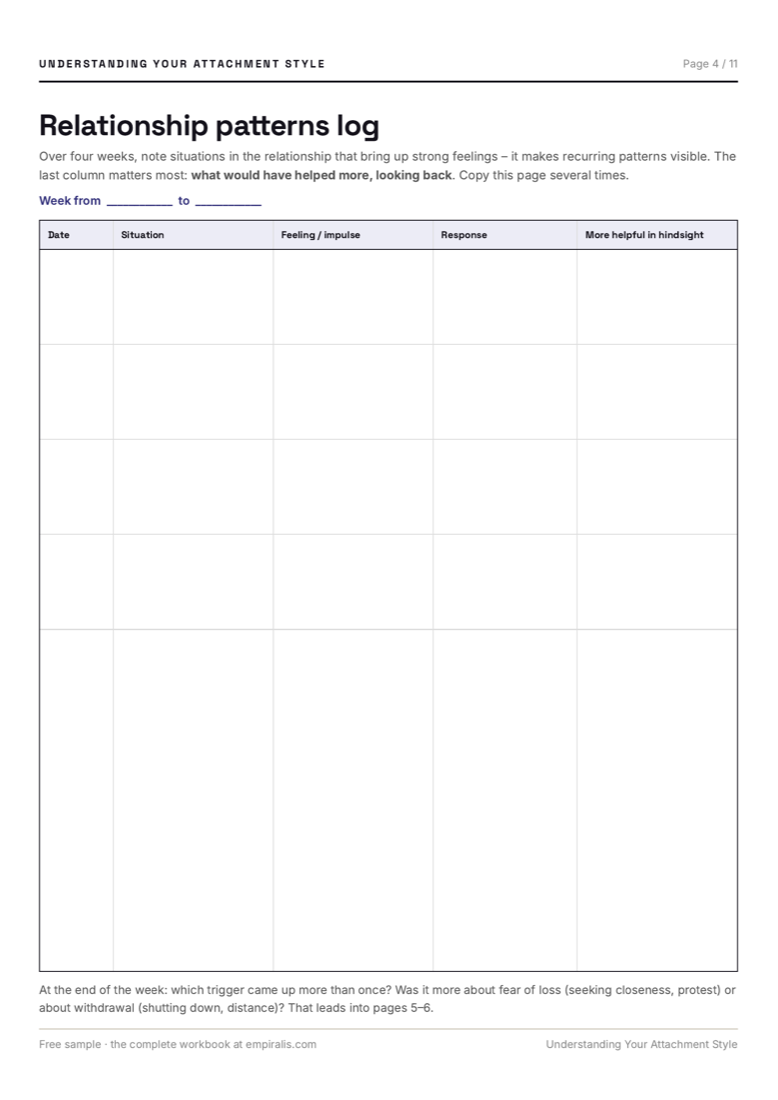
Relationship Patterns Log
Note situations with strong feelings in the relationship -- this makes recurring patterns visible.
| Date | Situation | Feeling/impulse | Reaction | In hindsight, more helpful would be |
|---|---|---|---|---|
Help resources
Couples counseling service
Often available through community or faith-based organizations, and low-cost.
locally
Licensed therapist
Also worthwhile individually, to work on your own attachment patterns.
locally