Adult ADHD: Information, Action Tips & Help
Why ADHD in adults is often recognized late -- and what genuinely eases daily life.
Often Recognized Late
ADHD is often associated only with hyperactive children -- but for many people, the core features of inattention, impulsivity, and inner restlessness persist into adulthood, just showing up differently: less visible hyperactivity, but more difficulty with organization, procrastination, missed appointments, or a constant feeling of "falling behind." Because that's easily mistaken for stress, anxiety, or exhaustion, many adults don't get diagnosed until years later.
What a Diagnosis Requires
An ADHD diagnosis doesn't rest on a single questionnaire -- it requires a thorough clinical evaluation, including evidence that similar difficulties were already present in childhood. Self-tests like the ASRS can offer a first indication, but they don't replace that evaluation.
Key point
A self-test like the ASRS can be a first indication -- an actual diagnosis always requires a thorough clinical evaluation, including evidence from childhood.
Worksheet pack for this topic
Focus & Structure
Focus & Structure
An ADHD workbook for adults: external structure instead of inner effort – built up over four weeks.
Related tests
Action tips
- Build external structure: let calendars, reminders, and checklists carry the organization that's harder to manage internally.
- Break large tasks into small, concrete steps instead of tackling them as a whole.
- Establish fixed routines for recurring tasks to reduce decision fatigue.
- Actively reduce distractions (e.g. put your phone in another room during focused work).
- Deliberately schedule movement breaks, instead of fighting the urge to move.
- Don't measure yourself against neurotypical standards -- a different way of working isn't automatically a worse one.
Checklist: On the Way to an ADHD Evaluation
- Took the ASRS screener and noted the result
- Gathered examples of childhood difficulties (report cards, memories, accounts from parents)
- Talked to someone you trust about it
- Made an appointment with a primary care doctor
- Looked into a practice or clinic specializing in ADHD evaluation
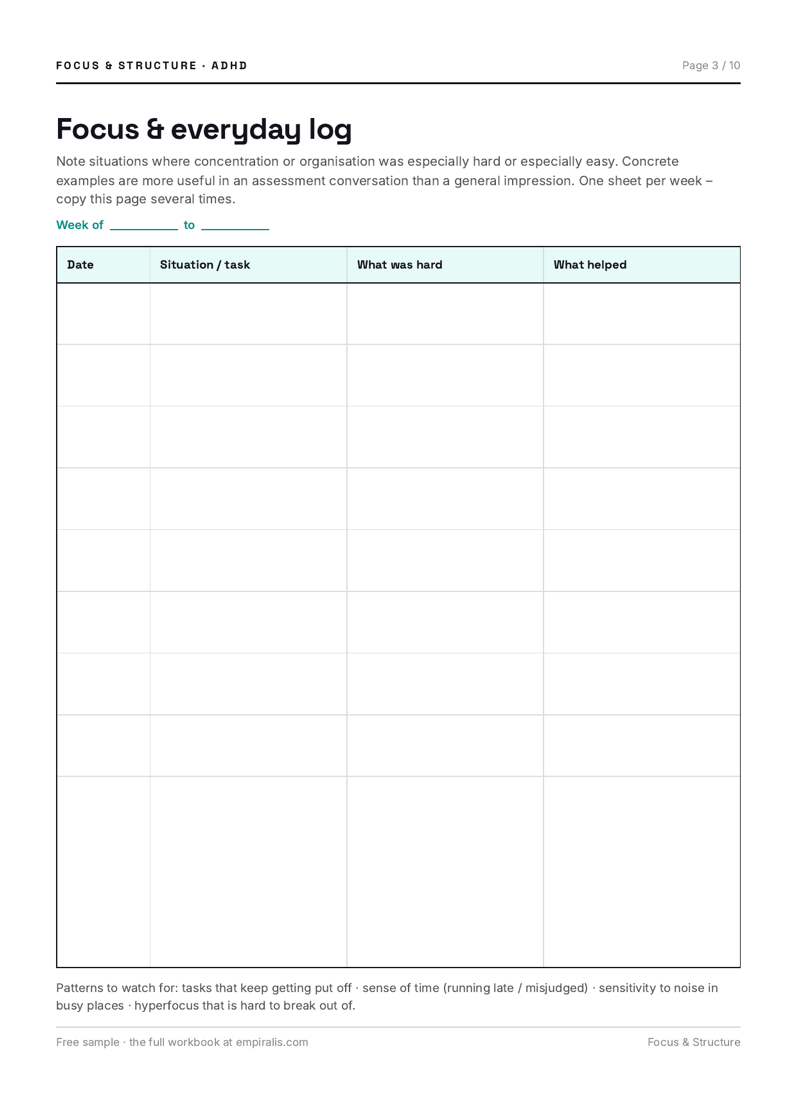
Focus and Daily Life Log
Note situations where concentration or organization is especially hard or especially easy -- concrete examples are more useful in an evaluation than a general impression.
| Date | Situation/task | What was hard | What helped |
|---|---|---|---|
What now?
The concrete next step: the real path to a diagnosis, contact points online and in person, and which of our worksheets fit where.
Help resources
Primary care doctor or psychiatrist
A good first stop for evaluation and referral to specialized diagnostics.
locally
CHADD (Children and Adults with ADHD)
A national nonprofit with information, support groups, and provider directories for ADHD.
chadd.org