Adult ADHD: The Path to Diagnosis
The ASRS or the Adult ADHD path gave you a first signal -- but what's the actual next step? The full path: where to start, real contact points online and locally, what the diagnostic evaluation looks like, and our workbook for the time in between.
Maybe you just took the ASRS because you've noticed for a while that things stay more chaotic and exhausting for you than they seem to for other people -- tasks that pile up, appointments you have to write down three times, the feeling of constantly working against your own head. And now a test has put a number on something you may have suspected for a long time.
An online screener like the ASRS can't make a diagnosis -- only a thorough clinical evaluation can. But a concerning result is a good reason to actually take the next step, instead of leaving it there. That's what this page is: not another self-assessment, but the concrete path there -- who does what, how to actually find a provider, what to expect in the evaluation, and what helps in the meantime.
The US doesn't have one single, centralized path the way some countries do -- what happens next can depend on your insurance, location, and which type of provider you see. Treat the steps below as orientation, not a promise of a specific timeline.
The Path to Diagnosis -- Step by Step
1. A primary care doctor, or go directly to a specialist
Your primary care doctor can rule out or flag other explanations for the symptoms (like sleep deprivation, thyroid issues, or depression) and refer you to a psychiatrist or psychologist. You can also often contact a specialist directly -- both paths are valid.
2. Finding the right specialist
A psychologist can diagnose ADHD and provide therapy, but can't prescribe medication. A psychiatrist can diagnose, prescribe, and manage medication. CHADD's Professional Directory (chadd.org/professional-directory) and Psychology Today's therapist finder, filtered for ADHD, both let you search for specialists by location and insurance.
3. The diagnostic evaluation
A thorough ADHD evaluation doesn't rest on a single questionnaire -- it's built on a structured clinical interview. DIVA-5 is a widely used structured interview that systematically reviews every DSM-5 criterion for both childhood and the present, using concrete everyday examples, and typically takes 60-90 minutes. It's usually paired with additional questionnaires, a look at other possible explanations (like depression, anxiety, or substance use), and, where possible, input from a partner or family member -- since one core criterion is that the difficulties were already present before age 12.
4. Diagnosis and next steps
The evaluation ends either with a diagnosis and a treatment plan (medication, therapy, coaching, or a combination) or with a well-reasoned conclusion that a different explanation fits better. Both are a real result of the evaluation, not a failure -- ADHD symptoms overlap with a lot of other things.
Resources Online
CHADD (Children and Adults with ADHD)
A national nonprofit with a professional directory, educational resources, and local chapters.
chadd.org →ADDA (Attention Deficit Disorder Association)
The largest US organization focused specifically on adults with ADHD, with virtual support groups and educational webinars.
add.org →Psychology Today Therapist Finder
Searchable directory of specialists, filterable by ADHD as a specialty, insurance, and location.
psychologytoday.com →Resources Locally
CHADD National Resource Center
Phone support for finding local ADHD resources, Monday-Friday, 1-5pm ET (Spanish available).
1-866-200-8098
ADDA
Support and information specifically for adults with ADHD.
800-939-1019
Primary care doctor or psychiatrist
A direct local contact point for evaluation and referral.
locally
A Workbook for the Time In Between
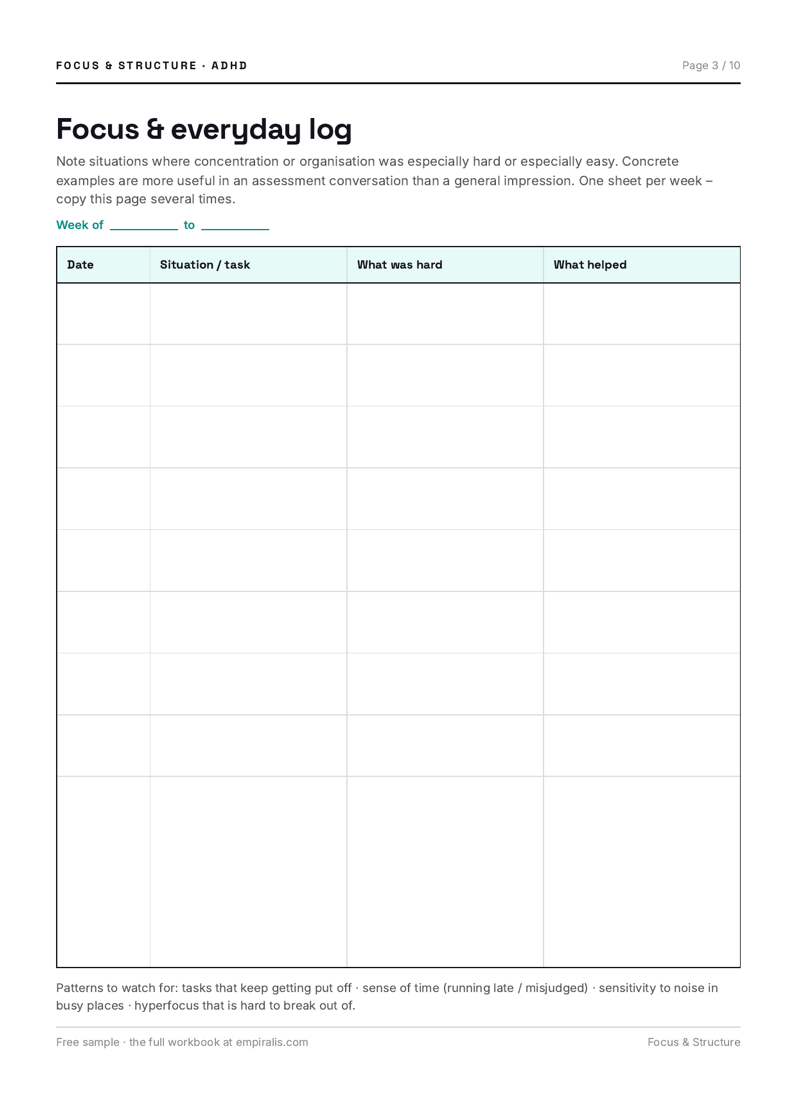
Weeks or months often pass between a first concern and the actual appointment. That time can be put to use: the more concrete your own observations are by the time you're in the room, the more you'll get out of the conversation.
More Tips for Daily Life
- Gather concrete examples instead of a general impression -- note situations where concentration or organization was especially hard, with the date and context.
- Build external structure: let calendars, reminders, and checklists carry the organization that's harder to manage internally.
- Break large tasks into small, concrete steps instead of tackling them as a whole.
- Establish fixed routines for recurring tasks to reduce decision fatigue.
- Actively reduce distractions (e.g. put your phone in another room during focused work).
- Don't measure yourself against neurotypical standards -- a different way of working isn't automatically a worse one.
Related on Empiralis