Eating Behavior: The Path to Support
The SCOFF questionnaire gave you a first signal -- but what's the actual next step? The full path: finding a specialized counseling service, real contact points online and locally, what a first conversation looks like, and our workbook for the time in between.
Maybe you filled out the SCOFF questionnaire because your relationship with food hasn't felt easy for a while -- and you're not sure yourself whether that's "normal" or something worth taking seriously. Both can be true at once, and a concerning result is a good reason to stop carrying that alone.
An online screener like the SCOFF questionnaire can't make a diagnosis -- only a thorough conversation with a professional can. But a concerning result is a good reason to actually take the next step. That's what this page is: not another self-assessment, but the concrete path there -- how to find the right support, what to expect once you're there, and what helps in the meantime.
The good news first: eating disorders are among the mental illnesses with the highest health risks, but they respond well to treatment when caught early -- and specialized support exists specifically for this, much of it free.
The Path to Support -- Step by Step
1. Primary care doctor
A good first step is an appointment with your primary care doctor -- not because it's strictly required, but because eating disorders can carry physical risks (like heart rhythm or electrolyte issues) worth monitoring medically. They can also refer you to specialized care.
2. Finding specialized support
ANAD's Treatment Directory (anad.org/treatment-directory) lists therapists, dietitians, physicians, and treatment centers specifically for eating disorders, filterable by location, type, and insurance. Both ANAD and the National Alliance for Eating Disorders also offer free helplines if you'd rather talk before searching.
3. The first conversation
The conversation covers your relationship with food and your body -- open-ended, without pressure toward a particular outcome. Together, you'll figure out what kind of support fits: ongoing counseling, outpatient therapy, or, for more severe cases, a higher level of care like a day program.
4. Ongoing treatment
If ongoing therapy is recommended, the directory or helpline can help you find a provider with availability -- specialized eating disorder treatment isn't available everywhere, so it can take some searching.
Resources Online
ANAD Treatment Directory
A searchable directory of therapists, dietitians, physicians, and treatment centers specializing in eating disorders, filterable by location and insurance.
anad.org/treatment-directory →National Alliance for Eating Disorders
Information, a treatment provider search, and support groups for eating disorders.
allianceforeatingdisorders.com →Resources Locally
ANAD Helpline
Free peer support and treatment referrals, Monday-Friday.
1-888-375-7767
National Alliance for Eating Disorders helpline
Free, confidential support for eating disorders.
1-866-662-1235
988 Suicide & Crisis Lifeline
Free, confidential, available 24/7. Call or text.
988
Primary care doctor
A good first stop for a medical check and referral to specialized care.
locally
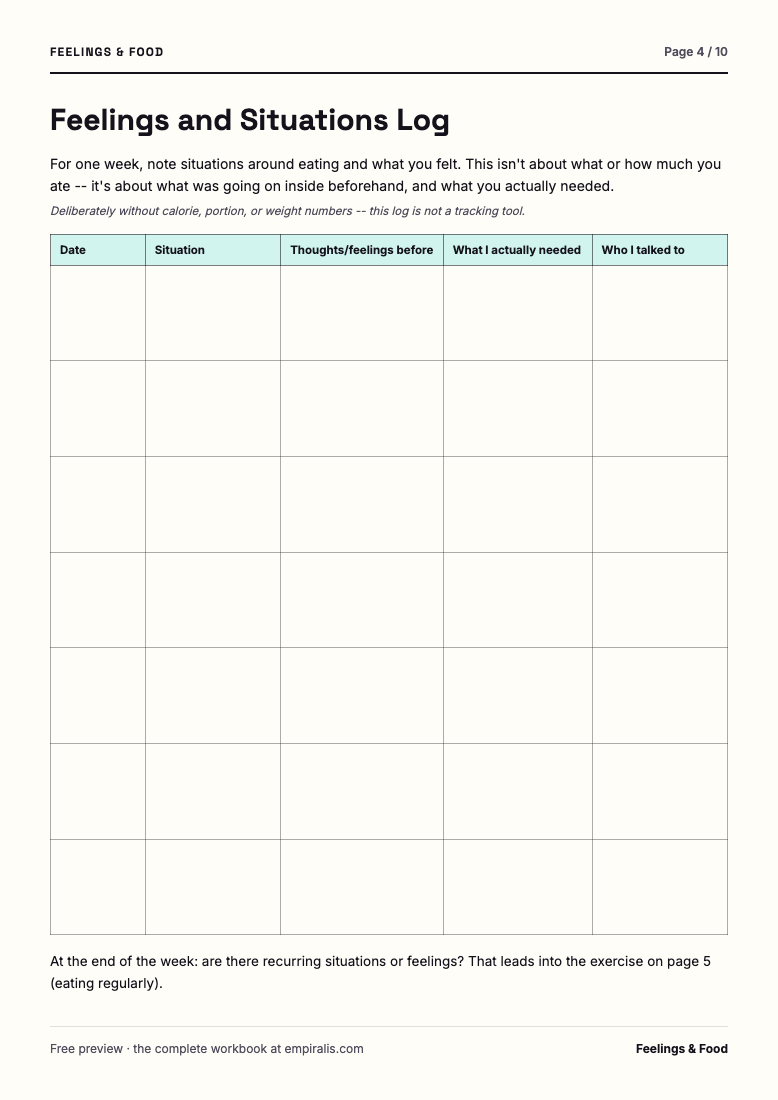
A Workbook for the Time In Between
There's often time before the first appointment. That time can be put to use: a workbook that's deliberately free of calorie or portion numbers, and instead helps you reflect on your relationship with food -- valuable for you, and for the first conversation with a provider.
More Tips for Daily Life
- Eat regularly rather than restrictively -- skipped meals often set up later binges.
- Don't use calorie-counting or constant weighing as a form of "self-therapy" -- it often reinforces the fixation.
- Talk to someone you trust, even when shame gets in the way -- most people who've been through it report afterward that this step was the hardest but most important one.
- Critically examine your social media consumption: deliberately cut back on content that glorifies body image or dieting.
- Seek professional help early -- the earlier treatment starts, the better the outlook.
Related on Empiralis