The SCOFF consists of just five yes/no questions and is used in primary care as a very brief first screen for possible signs of eating disorders like anorexia or bulimia. It doesn't replace a diagnostic evaluation, but can be a prompt to discuss your eating habits with a professional.
Comparison basis: 🏥 Clinical sample · Cut-off from the validation literature
Ready to start?
5 statements · ~1 min
What this test is based on
- Questions
- 5
- Minutes
- ca. 1
- Answer scale (steps)
- 0–1
- Dimension
- 1
The SCOFF was developed in 1999 by Morgan, Reid, and Lacey in a British primary-care sample and published in the BMJ. In the original study, a threshold of two or more "yes" answers correctly identified roughly 85-100% of people with a diagnosed eating disorder (sensitivity), with similarly high specificity. SCOFF has since been translated into numerous languages and validated internationally. As a pure brief screen, it can produce false positives and false negatives and doesn't replace a thorough evaluation.
What it measures
SCOFF Score
Number of "yes" answers (0–5).
Original source
- Morgan, J. F., Reid, F., & Lacey, J. H. (1999). The SCOFF questionnaire: Assessment of a new screening tool for eating disorders. BMJ, 319(7223), 1467–1468.
- Kutz, A. M., Marsh, A. G., Gunderson, C. G., Maguen, S., & Masheb, R. M. (2020). Eating disorder screening: A systematic review and meta-analysis of diagnostic test characteristics of the SCOFF. Journal of General Internal Medicine, 35(3), 885–893.
Was this useful?
Empiralis stays free. If you'd like to support it, every bit helps keep it independent.
Worksheet pack for this topic
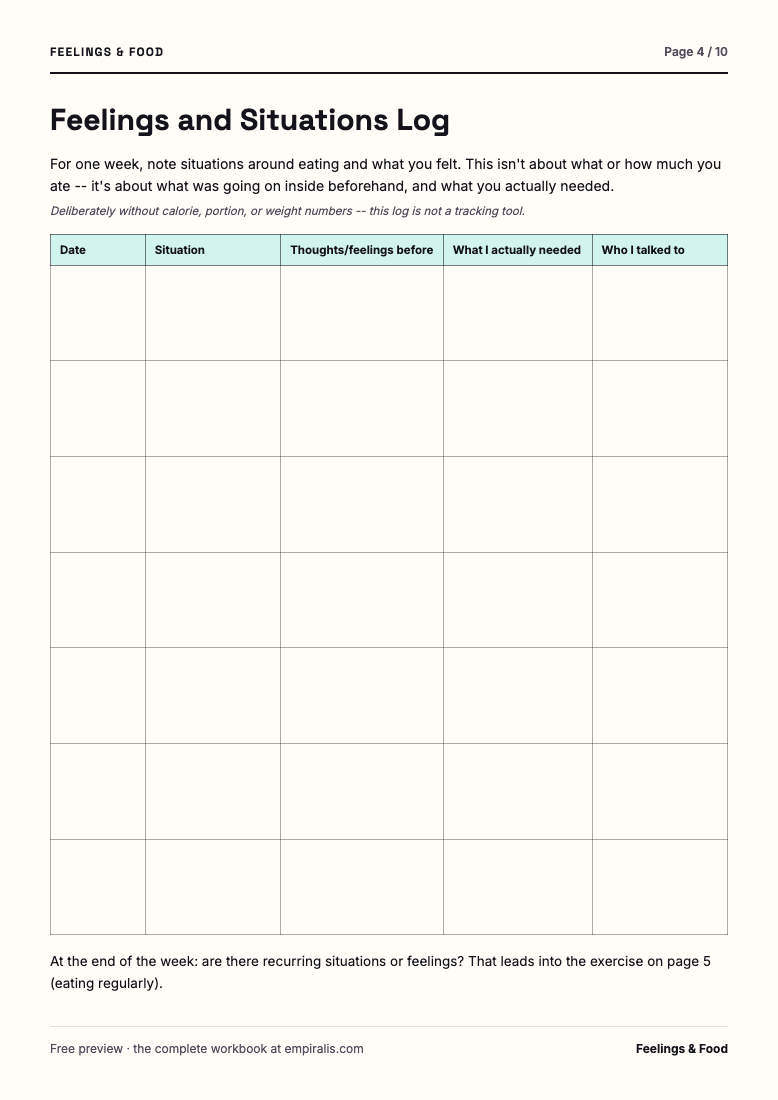
What now?
The concrete next step: the real path to a diagnosis, contact points online and in person, and which of our worksheets fit where.