Depression: The Path to Treatment
The PHQ-9 gave you a first signal -- but what's the actual next step? The full path: where to start, real contact points online and locally, what a first appointment looks like, and our workbook for the time in between.
Maybe you filled out the PHQ-9 because something has felt heavy for a while, in a way that's hard to put your finger on -- days blur together, things that used to feel easy now take real effort. Seeing that written out in black and white can hit hard. But it's also an honest first step, instead of staying alone with it.
An online screener like the PHQ-9 can't make a diagnosis -- only a thorough clinical evaluation can. But a concerning result is a good reason to actually take the next step. That's what this page is: not another self-assessment, but the concrete path there -- who does what, how to actually find a provider, what to expect once you're there, and what helps in the meantime.
The good news first: depression is among the best-researched and most treatable mental health conditions. The US doesn't have one single, centralized path to treatment the way some countries do -- what you do next depends partly on whether you have insurance -- but there are real, working paths either way, and none of them require a referral just to start looking.
The Path to Treatment -- Step by Step
1. A primary care doctor, or go directly to a therapist
Most insurance plans don't require a referral for outpatient therapy -- you can generally contact a therapist directly. Seeing your primary care doctor first is also a valid path, especially to rule out physical causes (like thyroid issues) or to get a recommendation. Either way works; what matters is taking one of them.
2. Finding a provider
If you have insurance, your insurer's website or the number on your card will list in-network therapists and psychiatrists. Either way, Psychology Today's therapist finder (psychologytoday.com) lets you filter by specialty, insurance, and sliding-scale availability. If cost is a barrier, a Federally Qualified Health Center offers therapy on a legally required sliding scale regardless of insurance status -- find one at findahealthcenter.hrsa.gov.
3. The first appointment
A first session is usually an intake evaluation: a longer conversation covering your symptoms, history, and current life situation. By the end, the provider will typically share their impression and a recommendation for next steps -- for example, ongoing weekly therapy, a referral for a medication evaluation, or that a different kind of support fits better.
Resources Online
Psychology Today Therapist Finder
A free, searchable directory of therapists and psychiatrists, filterable by specialty, insurance, location, and sliding-scale availability.
psychologytoday.com →FindTreatment.gov
SAMHSA's federal treatment locator for mental health and substance use facilities nationwide, searchable by payment option including sliding scale and free care.
findtreatment.gov →Open Path Psychotherapy Collective
A nonprofit network offering therapy sessions at reduced rates, typically $30-80, for people without adequate insurance coverage.
openpathcollective.org →Resources Locally
988 Suicide & Crisis Lifeline
Free, confidential, available 24/7 -- also for support that isn't an acute emergency.
988
SAMHSA's National Helpline
Free, confidential referrals to local treatment facilities and support services.
1-800-662-4357
Federally Qualified Health Center
Primary care and mental health services on a legally required sliding scale, regardless of insurance status. Find one via findahealthcenter.hrsa.gov.
locally
Primary care doctor or therapist
A direct local contact point -- no referral typically needed for outpatient therapy.
locally
A Workbook for the Time In Between
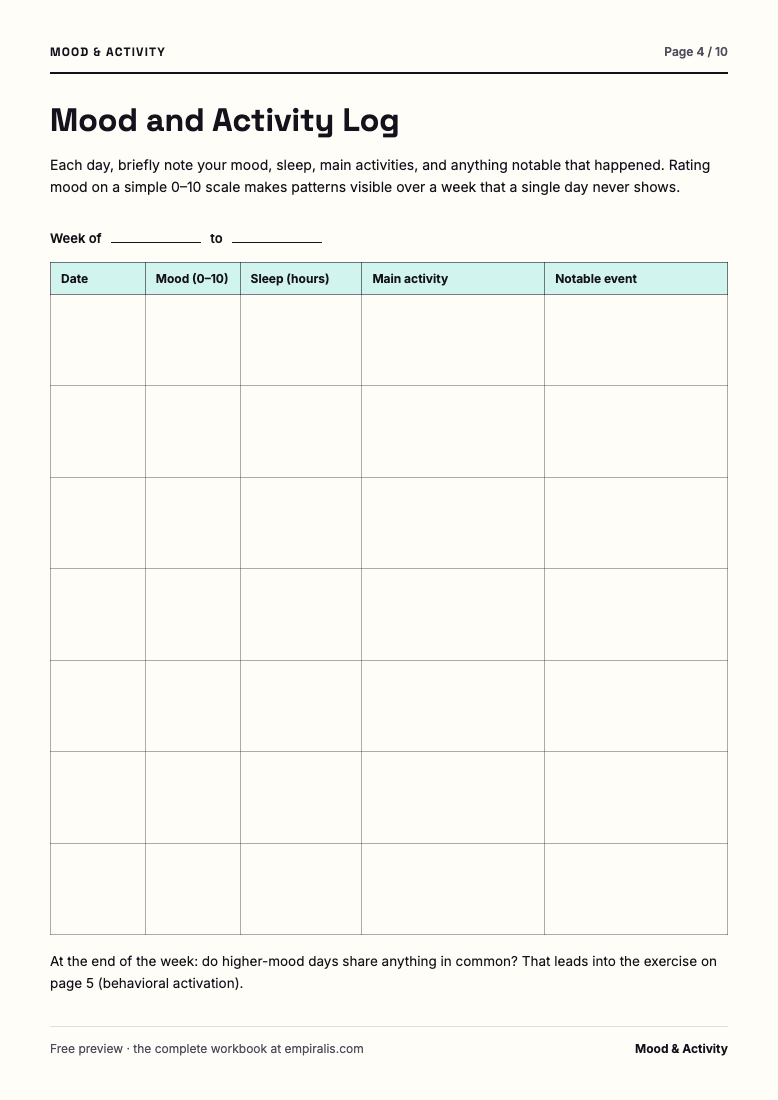
Weeks often pass between a first concern and an actual appointment. That time can be put to use: a mood and activity log makes visible what helps and what weighs you down -- valuable for you, and for the conversation in your first session.
More Tips for Daily Life
- Behavioral activation: deliberately schedule small, pleasant, or meaningful activities -- even without feeling like it, the doing itself can lift mood.
- Keep a fixed daily structure: regular wake and sleep times give you something to hold onto when internal motivation is missing.
- Don't fully withdraw from social contact, even when the urge to isolate is strong -- brief, low-effort contact still helps.
- Exercise: even moderate physical activity (like walking three times a week) shows a measurable effect on depressive symptoms in studies.
- Recognize self-critical thoughts as a symptom, not a fact.
- Don't wait until it feels "bad enough" to seek help -- early support tends to work better than waiting.
Related on Empiralis