Mood & Activity
Mood & Activity
A workbook for the PHQ-9: track mood and activity for a month, with behavioral activation, a fixed daily structure, and small steps against social withdrawal -- over four weeks.
€4.00 · 10 pages, A4, PDF
Buy on Ko-fi →Checkout and instant download via Ko-fi.
The PHQ-9 tracks how often nine core symptoms of a depressive episode have shown up over the last two weeks -- from loss of interest and low mood, to sleep and concentration problems, to thoughts of self-harm. It's a screening tool, not a diagnosis. This workbook turns the result into four weeks of concrete work: logging mood and activity daily, deliberately scheduling small, meaningful activities back in (behavioral activation), building a fixed daily structure, recognizing self-critical thoughts as a symptom rather than a fact, and gradually working against withdrawal from social contact. It doesn't replace therapy, but it can help you prepare for it or support it alongside.
What's inside
- How to use this workbook -- what the PHQ-9 measures, how to read the thresholds, and when professional help makes sense
- Baseline: place your PHQ-9 score and name the strongest of your nine symptoms
- Mood and activity log: for one week, track mood, sleep, activity, and events each day
- Behavioral activation: build a list of pleasant and meaningful activities and schedule three of them for next week -- even without feeling like it
- A fixed daily structure: set wake and sleep times and a simple day plan for low-motivation stretches
- Self-critical thoughts: collect recurring negative thoughts and recognize them as a symptom, not a fact
- Social withdrawal: notice which contacts you're avoiding, and deliberately reach out to one low-effort contact this week
- Plan the week and look back: set small steps, review the log, retake the PHQ-9
- Notes and source
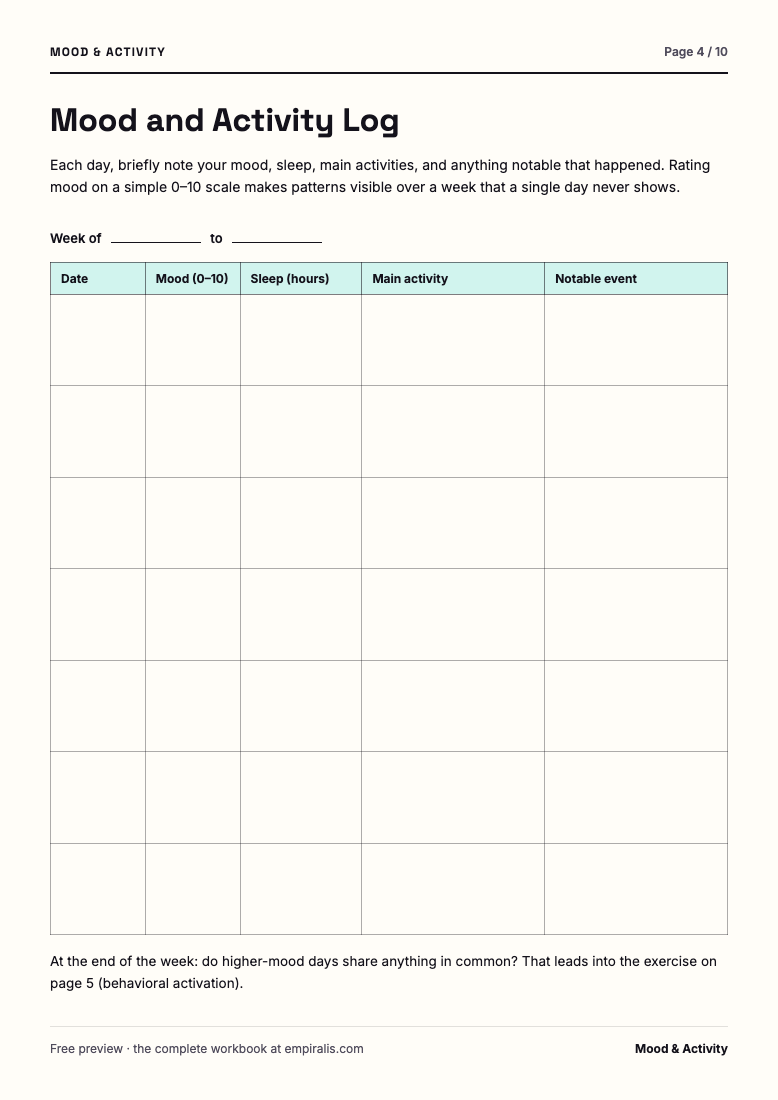
Free preview: Mood and activity log (page 4)
Enter your email — we'll send you the download link. The first time, you'll confirm your address via a link first; if you're already subscribed, the download link comes straight away. Either way you're subscribed to the Empiralis newsletter (unsubscribe any time).
Scientific basis
- Kroenke, K., Spitzer, R. L., & Williams, J. B. W. (2001). The PHQ-9: Validity of a brief depression severity measure. Journal of General Internal Medicine, 16(9), 606–613. — The PHQ-9 is in the public domain and may be reproduced, translated, and used without permission.
- National Institute for Health and Care Excellence (2022). Depression in adults: treatment and management (NG222). — Referenced as the basis for this workbook's exercises: behavioral activation (scheduling meaningful activities despite low motivation), a fixed daily structure, and recognizing self-critical automatic thoughts are established, empirically supported elements of cognitive behavioral therapy for depression. The exercises are adapted for self-guided use and don't replace therapy.
Related on Empiralis