Feelings & Food
Feelings & Food
A workbook for the SCOFF: reflect on your relationship with food, find your way back to a regular rhythm, and prepare a first conversation -- over four weeks, deliberately without calories or portion counts.
€4.00 · 10 pages, A4, PDF
Buy on Ko-fi →Checkout and instant download via Ko-fi.
The SCOFF is just five yes/no questions, used in primary care as a very brief first screen for possible signs of an eating disorder. It's a screening tool, not a diagnosis. This workbook turns that into four weeks of gentle work: reflecting on your relationship with food, finding your way back to a regular rhythm instead of more control, and preparing the often-hardest step -- talking to someone about it. Deliberately without calorie, portion, or weight numbers: this workbook is not a diet or tracking tool and isn't meant to be used like one. It doesn't replace medical, psychotherapeutic, or nutritional treatment, but it can help you prepare for it or support it alongside.
What's inside
- How to use this workbook -- what the SCOFF measures, how to read the result, and when professional help makes sense
- Baseline: note your SCOFF result and briefly capture your current thoughts about food
- Feelings and situations log: for one week, track situations and feelings around eating -- deliberately without calories or portion counts
- Eating regularly: finding a simple rhythm of fixed mealtimes instead of skipping meals
- Why diets and calorie-counting don't help: understanding why strict control often worsens eating patterns rather than improving them
- What I want to talk about: preparing a conversation with someone you trust, even when shame gets in the way
- A closer look at social media: critically examining content that glorifies body image or dieting
- Plan the week and look back: set small steps, review the log, retake the SCOFF
- Notes and source
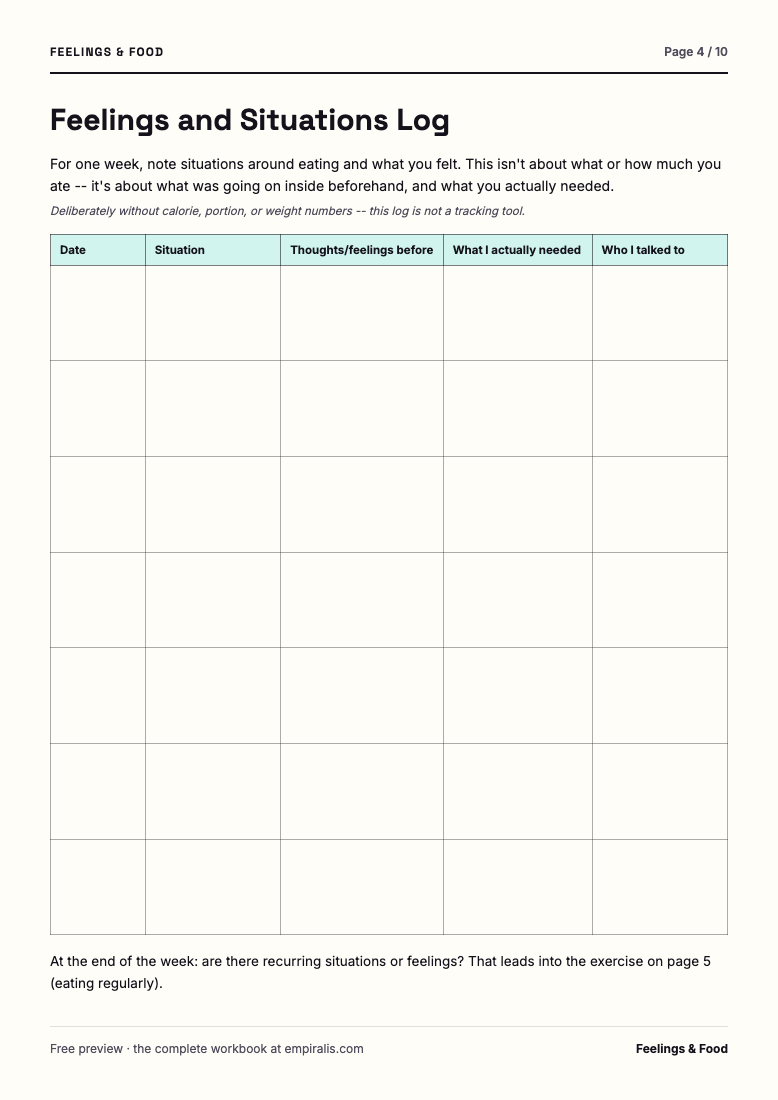
Free preview: Feelings and situations log (page 4)
Enter your email — we'll send you the download link. The first time, you'll confirm your address via a link first; if you're already subscribed, the download link comes straight away. Either way you're subscribed to the Empiralis newsletter (unsubscribe any time).
Scientific basis
- Morgan, J. F., Reid, F., & Lacey, J. H. (1999). The SCOFF questionnaire: Assessment of a new screening tool for eating disorders. BMJ, 319(7223), 1467-1468. — The five SCOFF questions were published in full in the original article and are widely reproduced verbatim with citation across health services and public-health screening toolkits worldwide.
- Polivy, J., & Herman, C. P. (1985). Dieting and binging: A causal analysis. American Psychologist, 40(2), 193-201. — Referenced as evidence that strict dietary control (cognitively driven rather than physically regulated eating) can increase the risk of loss of control and binge eating -- the scientific basis for why this workbook deliberately guides toward regular eating instead of more control.