Depression: Information, Action Tips & Help
What a depressive episode actually is, what research shows genuinely helps, and where to find support.
What Is Depression?
A depressive episode is more than a passing low mood: it shows up as persistent sadness, loss of interest or pleasure, and low energy lasting at least two weeks, often alongside changes in sleep, concentration, or appetite. It's one of the most common mental health conditions, affecting people across every age group and life circumstance -- regardless of how "good" a life looks from the outside.
What Research Says About Effective Help
Depression is among the best-researched and most treatable mental health conditions. Psychotherapy -- especially cognitive behavioral therapy -- shows strong effectiveness across numerous studies, often combined with medication for moderate to severe episodes. Even for milder episodes, starting treatment early is associated with better odds of improvement than waiting it out.
Key point
Depression is among the most treatable mental health conditions -- starting treatment early is associated with better outcomes than waiting.
Was this useful?
Empiralis stays free and ad-supported. If you'd like to support it directly instead, every bit helps keep it independent.
Worksheet pack for this topic
Mood & Activity
Mood & Activity
A workbook for the PHQ-9: track mood and activity for a month, with behavioral activation, a fixed daily structure, and small steps against social withdrawal -- over four weeks.
Related tests
Action tips
- Behavioral activation: deliberately schedule small, pleasant, or meaningful activities -- even without feeling like it, the doing itself can lift mood.
- Keep a fixed daily structure: regular wake and sleep times give you something to hold onto when internal motivation is missing.
- Don't fully withdraw from social contact, even when the urge to isolate is strong -- brief, low-effort contact still helps.
- Exercise: even moderate physical activity (like walking three times a week) shows a measurable effect on depressive symptoms in studies.
- Recognize self-critical thoughts as a symptom, not a fact.
- Don't wait until it feels "bad enough" to seek help -- early support tends to work better than waiting.
Checklist: First Steps If You Suspect Depression
- Took the PHQ-9 and noted the result
- Talked to someone you trust about it
- Made an appointment with a primary care doctor
- Have the 988 Suicide & Crisis Lifeline number on hand for acute moments
- Looked into how to find a therapist (e.g. via SAMHSA's National Helpline)
- Set one small, doable step for today
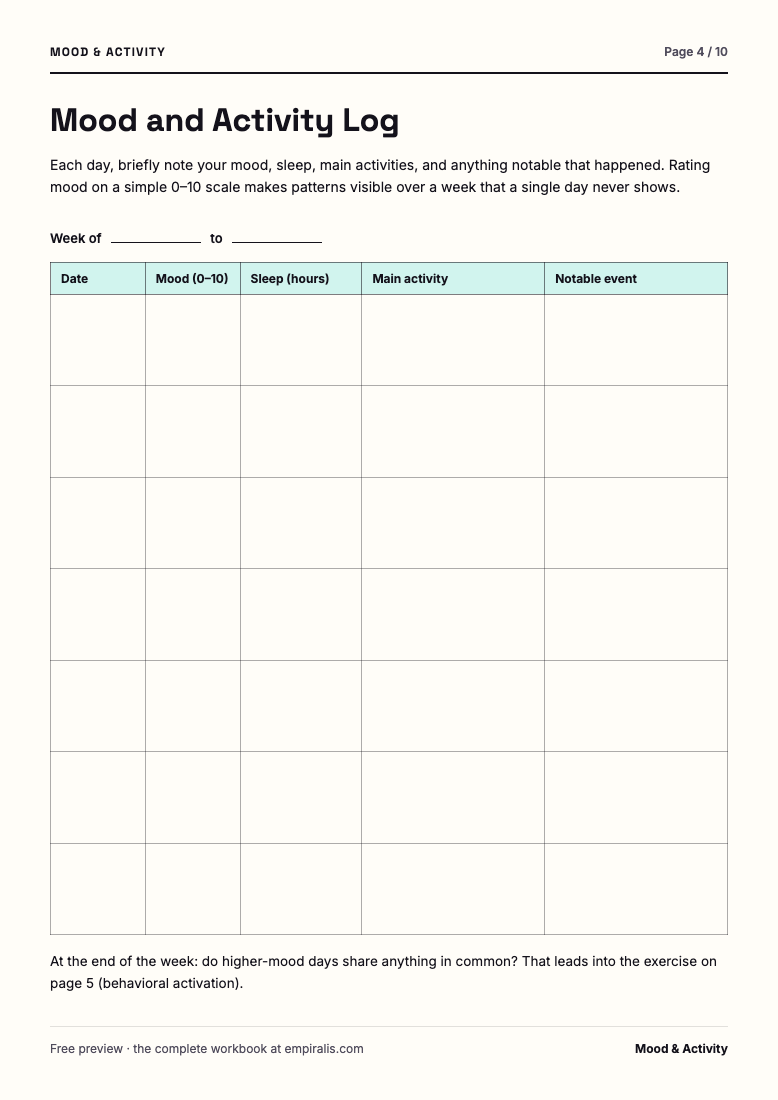
Mood and Activity Log
A short daily entry helps you -- and, if relevant, your doctor or therapist -- spot patterns over time.
| Date | Mood (1-10) | Sleep (hrs) | Activity/event | Note |
|---|---|---|---|---|
What now?
The concrete next step: the real path to a diagnosis, contact points online and in person, and which of our worksheets fit where.
Help resources
988 Suicide & Crisis Lifeline
Free, confidential, available 24/7. Call or text.
988
SAMHSA's National Helpline
Free, confidential referrals to local treatment and support services.
1-800-662-4357
Primary care doctor or therapist
A good first stop for evaluation, support, and referral.
locally