Alcohol & Substances: The Path to Counseling
The AUDIT gave you a first signal -- but what's the actual next step? The full path: finding a counseling service, real contact points online and locally, what a first conversation looks like, and our workbook for the time in between.
Maybe you filled out the AUDIT because a quiet concern about your own use has been showing up for a while -- even if everything still looks fine from the outside. That's not a reason to judge yourself; it's a good moment to look honestly, while change is still easy.
An online screener like the AUDIT can't make a diagnosis -- only a conversation with a professional can. But a concerning result is a good reason to actually take the next step. That's what this page is: not another self-assessment, but the concrete path there -- how to actually find a counseling service, what to expect once you're there, and what helps in the meantime.
The good news first: reaching out for addiction counseling doesn't require a diagnosis or a referral, and free and confidential options exist regardless of insurance status. Most people are surprised by how low the barrier actually is to start.
The Path to Counseling -- Step by Step
1. Finding a counseling service
SAMHSA's FindTreatment.gov (findtreatment.gov) is the federal locator for addiction treatment facilities nationwide, searchable by location and payment option including free and sliding-scale care. SAMHSA's National Helpline (1-800-662-4357) offers the same referrals by phone, 24/7.
2. The first conversation
A first, confidential conversation covers your use, background, and your own goals -- anywhere from cutting back to full abstinence, whatever fits you. Good counseling stays open-ended; it's not about prescribing you a particular outcome.
3. Assessment and, if needed, referral
Together, you'll get a sense of where your use falls on the spectrum from low-risk to dependent, and what makes sense next. If needed, the counselor can refer you to outpatient or inpatient treatment and help you sort out the practical steps, including what your insurance covers.
4. Ongoing support
Many counseling services also offer longer-term check-ins, whether or not formal treatment follows. Mutual-aid groups like Alcoholics Anonymous or the secular alternative SMART Recovery can be a valuable addition. Research on brief interventions shows that even a single structured conversation about your own drinking can measurably change drinking behavior -- especially early, before dependence sets in.
Resources Online
FindTreatment.gov
SAMHSA's federal treatment locator for addiction treatment facilities nationwide, searchable by payment option including sliding scale and free care.
findtreatment.gov →SMART Recovery
A free, secular, evidence-based alternative to 12-step programs, with in-person and online meetings.
smartrecovery.org/meeting →Resources Locally
SAMHSA's National Helpline
Free, confidential, available 24/7. Treatment referrals for alcohol and other substances.
1-800-662-4357
Federally Qualified Health Center
Addiction counseling and primary care on a legally required sliding scale, regardless of insurance status. Find one via findahealthcenter.hrsa.gov.
locally
Primary care doctor
A good first stop for a health check and referral to specialized care.
locally
A Workbook for the Time In Between
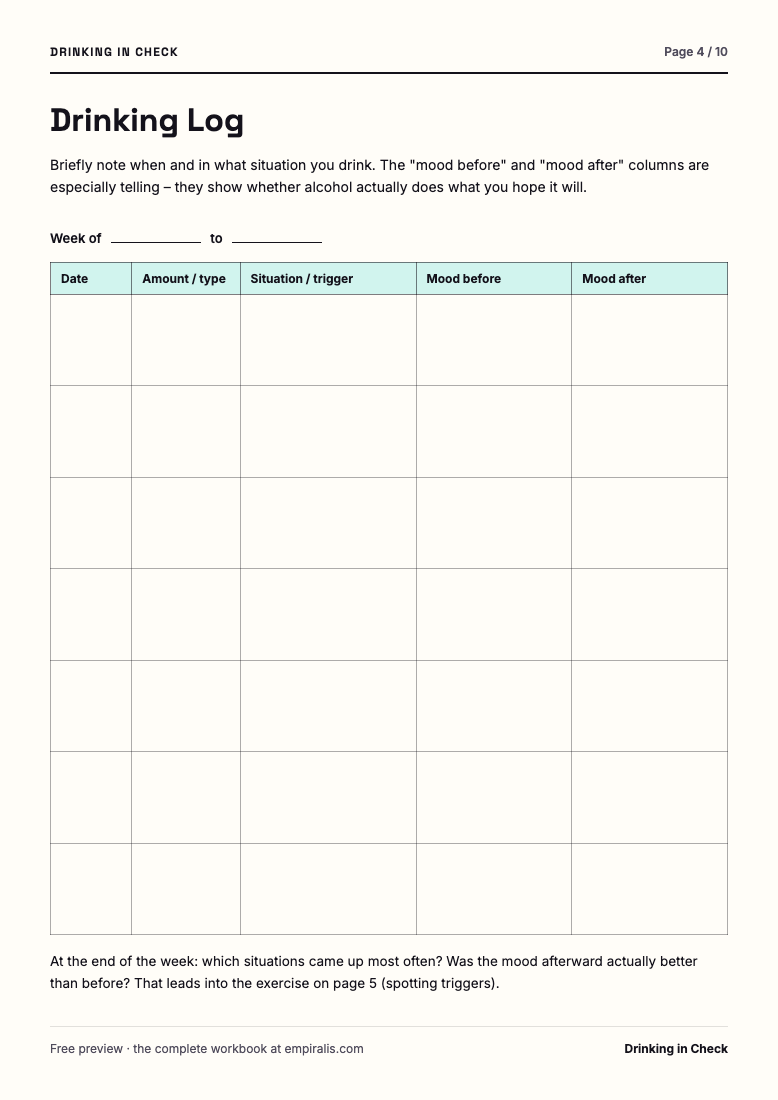
There's often time before the first counseling appointment. That time can be put to use: an honest drinking log makes patterns and triggers visible -- valuable for you, and for the first conversation with a counselor.
More Tips for Daily Life
- Document your use first, before trying to change it -- this creates an honest picture without immediate pressure to act.
- Deliberately plan drink-free days during the week, instead of treating full abstinence as the only option.
- Identify your triggers: what time of day, with whom, and in what mood are you most likely to use?
- Think through alternatives for social situations where use has so far been automatic.
- Don't go it alone -- talk to someone you trust or a counseling service, even if it feels uncomfortable.
- A setback isn't a failure -- it's normal in many change processes. What matters is continuing afterward instead of giving up.
Related on Empiralis