The UCLA Loneliness Scale uses 20 statements to measure how often you experience feelings of loneliness and a lack of social connectedness -- regardless of how many social contacts you actually have.
Comparison basis: 🎓 Student sample · Cut-off from the validation literature
Ready to start?
20 statements · ~5 min
What this test is based on
- Questions
- 20
- Minutes
- ca. 5
- Answer scale (steps)
- 1–4
- Dimension
- 1
The UCLA Loneliness Scale was originally developed in 1978 by Russell, Peplau, and Ferguson, and revised by Daniel Russell into the third version used here in 1996. It's the most widely used research instrument in the world for measuring subjective loneliness and shows very good internal consistency across numerous studies (Cronbach's alpha usually above .90).
Importantly: the scale measures the subjective feeling of loneliness, not the objective number of social contacts -- you can feel lonely in a crowd, and be alone without feeling lonely.
The bands used here are based on the reference values reported in the original study (Russell, 1996, Table 2) for two adult samples using the full 20-item scale (college students, N=487, M=40.08, SD=9.50; nursing staff, N=305, M=40.14, SD=9.52): the "average" range corresponds to roughly one standard deviation around that pooled mean (M≈40.1, SD≈9.5). The original study does not define a formal clinical cutoff -- the scale is meant to be interpreted dimensionally, not categorically.
What it measures
Experienced Loneliness
Sum across all 20 items, shown as a percentage.
Original source
- Russell, D. W. (1996). UCLA Loneliness Scale (Version 3): Reliability, validity, and factor structure. Journal of Personality Assessment, 66(1), 20–40.
Was this useful?
Empiralis stays free. If you'd like to support it, every bit helps keep it independent.
Worksheet pack for this topic
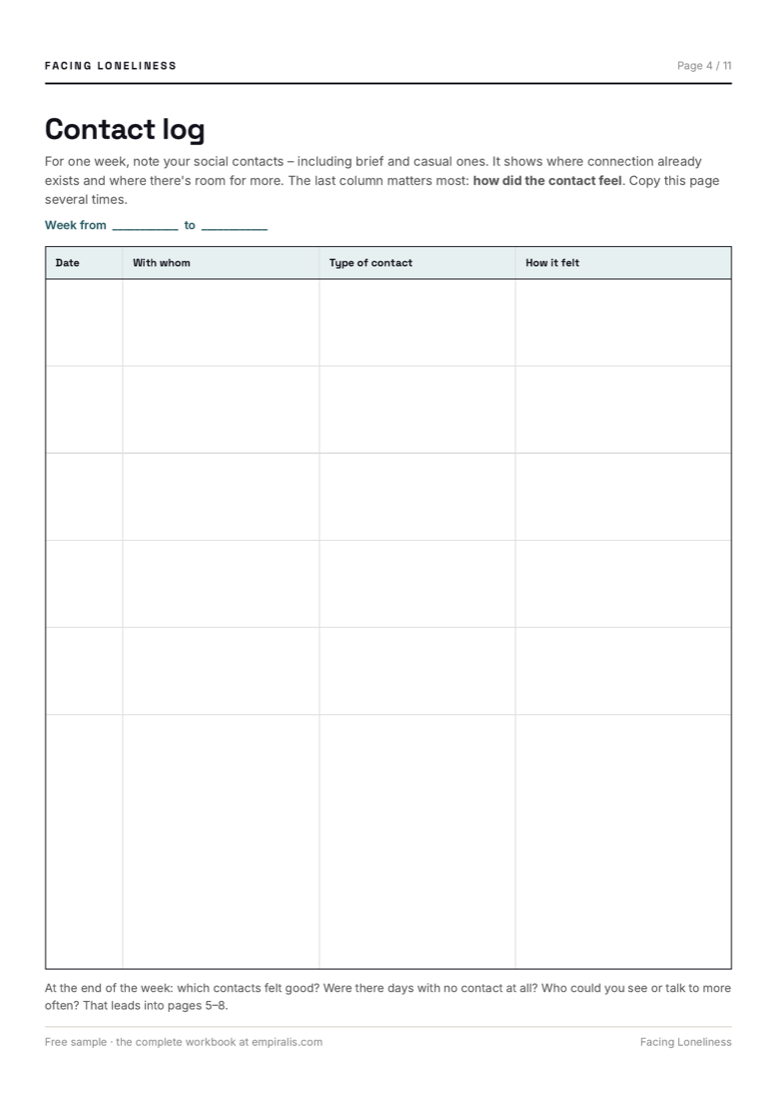
Want to go deeper?
This test is one signal among several. A guided path combines it with a few others instead of a single score.
What now?
The concrete next step: the real path to a diagnosis, contact points online and in person, and which of our worksheets fit where.