The Family APGAR uses five statements to capture how satisfied you are with core functions of your family: mutual support, communication, growth/independence, affection, and shared time. "Family" here means whoever plays that role for you -- it doesn't have to be your family of origin.
Comparison basis: 🔀 Mixed samples · Cut-off from the validation literature
Ready to start?
5 statements · ~2 min
What this test is based on
- Questions
- 5
- Minutes
- ca. 2
- Answer scale (steps)
- 0–2
- Dimension
- 1
The Family APGAR was developed in 1978 by family physician Gabriel Smilkstein to quickly assess family function in a primary care setting -- named after the well-known APGAR score from obstetrics. The name is an acronym for the five areas it covers: Adaptation (support), Partnership (communication), Growth, Affection, and Resolve (shared time/connectedness). Studies consistently show high internal consistency (Cronbach's alpha .80-.90) and good test-retest reliability.
Factor analyses suggest the five items mostly capture a single, global dimension of "satisfaction with family" rather than five separate constructs.
What it measures
Satisfaction with Family Function
Sum across all five items (0–10 points).
Original source
- Smilkstein, G. (1978). The family APGAR: A proposal for a family function test and its use by physicians. The Journal of Family Practice, 6(6), 1231–1239.
- Smilkstein, G., Ashworth, C., & Montano, D. (1982). Validity and reliability of the family APGAR as a test of family function. The Journal of Family Practice, 15(2), 303–311.
Was this useful?
Empiralis stays free. If you'd like to support it, every bit helps keep it independent.
Worksheet pack for this topic
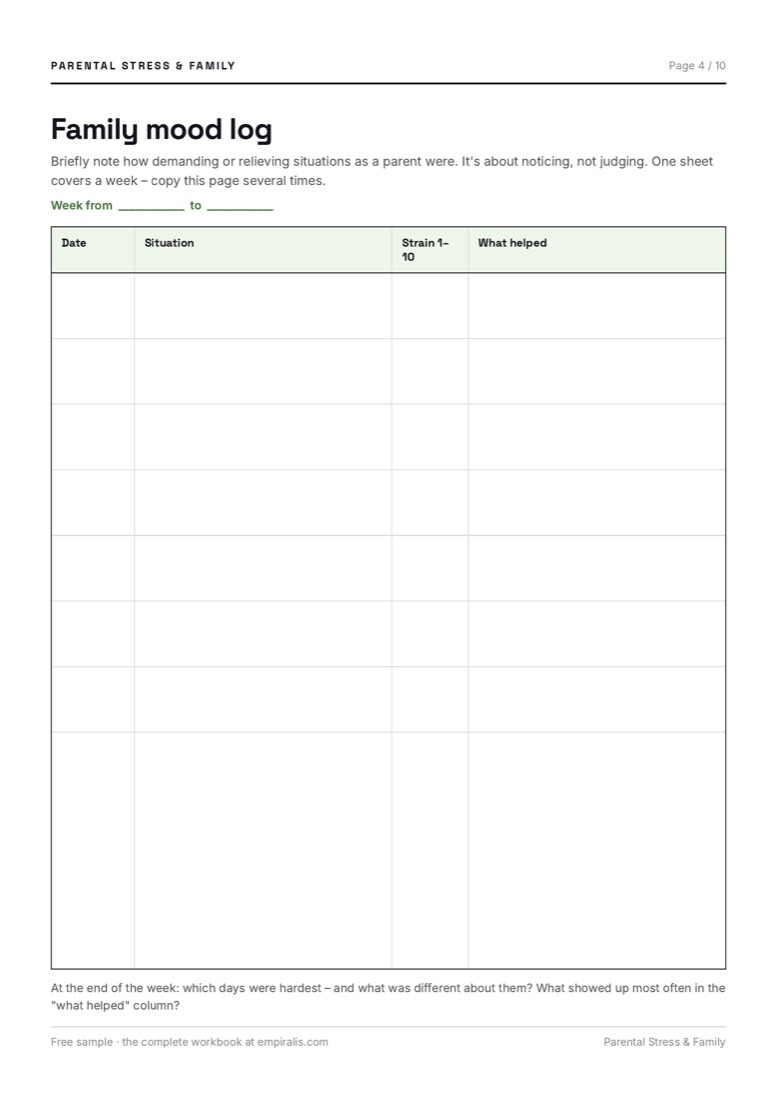
Want to go deeper?
This test is one signal among several. A guided path combines it with a few others instead of a single score.