Burnout Recovery Plan
A workbook: burnout is more than a hard day, but not a fixed trait – recognise exhaustion, set boundaries and schedule recovery over four weeks.
€4.00 · 11 pages, A4, PDF
Buy on Ko-fi →Checkout and instant download via Ko-fi.
The Copenhagen Burnout Inventory measures exhaustion separately by three sources: personal, work-related and client-related. Burnout is not a stable personality trait but a state that can change – in both directions. The longer straining structures stay unchanged, the more the exhaustion sets in; countering it early markedly increases the chance of noticeable improvement. This workbook turns that into four weeks of concrete steps.
What's inside
- How to use the workbook – what the CBI measures and why countering it early matters
- Baseline: the three CBI scores and your own warning signs
- Energy log: two weeks of what costs energy and what gives it
- Energy drains and energy sources: pull out the patterns and prioritise
- Boundaries between work and recovery: set concrete rules
- Recovery as an appointment, not leftover time: micro-breaks and a fixed recovery block
- Name the strains instead of carrying them: the three biggest and one possible step each
- Asking for support: points of contact, what to ask for, ready-made sentences
- Looking back after four weeks, an early-warning system and when medical help is needed
- Notes and sources
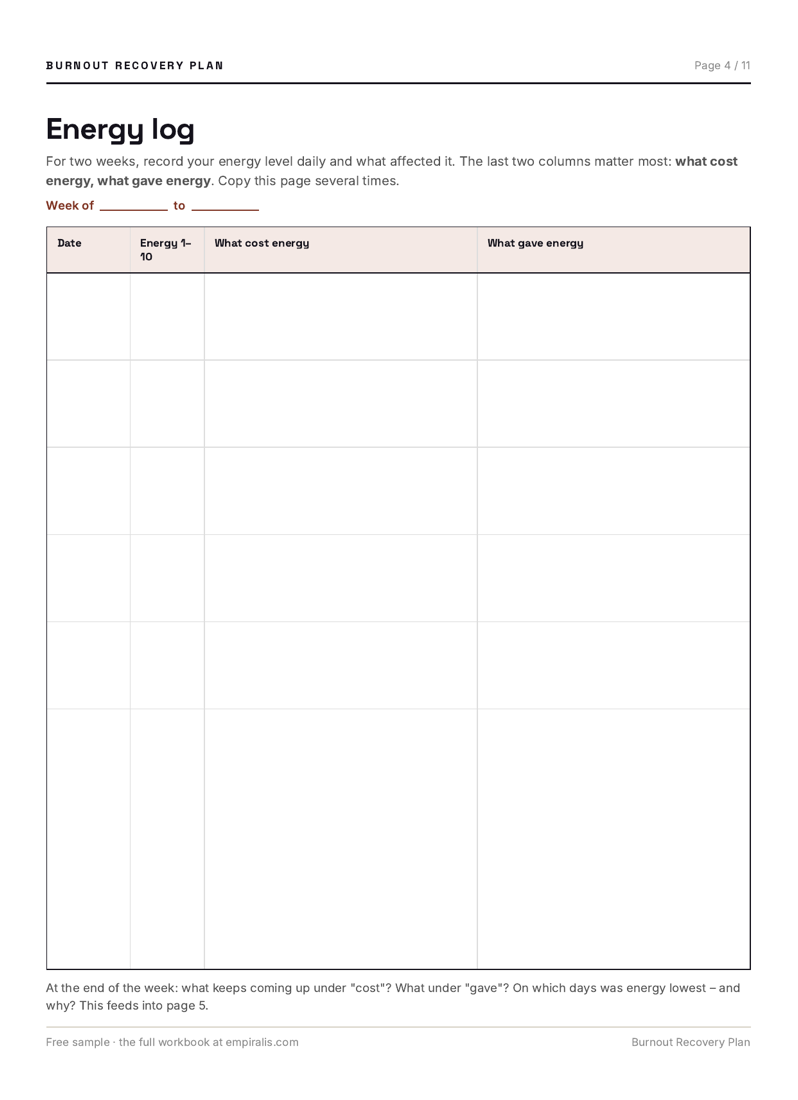
Free preview: Energy log (page 4)
Enter your email — we'll send a confirmation link. After confirming you go straight to the download. You'll also be subscribed to the Empiralis newsletter (unsubscribe any time).
Scientific basis
- Kristensen, T. S., Borritz, M., Villadsen, E., & Christensen, K. B. (2005). The Copenhagen Burnout Inventory: A new tool for the assessment of burnout. Work & Stress, 19(3), 192–207. — The Copenhagen Burnout Inventory is in the public domain and was developed explicitly as a free alternative to licensed burnout instruments.
- Borritz, M., & Kristensen, T. S. (2004). Copenhagen Burnout Inventory: Normative data from a representative Danish population and results from the PUMA study. National Institute of Occupational Health, Copenhagen. — Freely available normative document; contains the cutoff of 50+ points = high burnout.
Related on Empiralis