Understanding Your Attachment Style
A workbook on attachment anxiety and attachment avoidance: spot your own patterns, say needs as a request rather than a reproach, repair after conflict – a companion to the ECR-R.
€4.00 · 11 pages, A4, PDF
Buy on Ko-fi →Checkout and instant download via Ko-fi.
The ECR-R measures attachment style along two dimensions: attachment anxiety (worry about being rejected or abandoned) and attachment avoidance (discomfort with closeness and dependence). Both are protective strategies learned early, not character flaws – and they can shift toward more secure patterns over time. This workbook turns that into four weeks of concrete work: observing, spotting triggers, putting needs into words, self-soothing and repairing conflicts.
What's inside
- How to use the workbook – what the ECR-R measures and why attachment patterns can change
- Baseline: your scores for attachment anxiety and avoidance, and where you land in the style field
- Relationship patterns log: four weeks of recording situations that bring up strong feelings
- Your triggers: what wakes fear of loss, what sparks withdrawal, early warning signs
- Protest or withdrawal: what the system does when it feels insecure – and what's missing underneath
- Put needs into words instead of hoping: from reproach to a concrete request
- Working against your own pattern: self-soothe, or small steps toward closeness
- The repair conversation after an argument: the sequence and a template
- Looking back after four weeks and when counselling makes sense
- Notes and sources
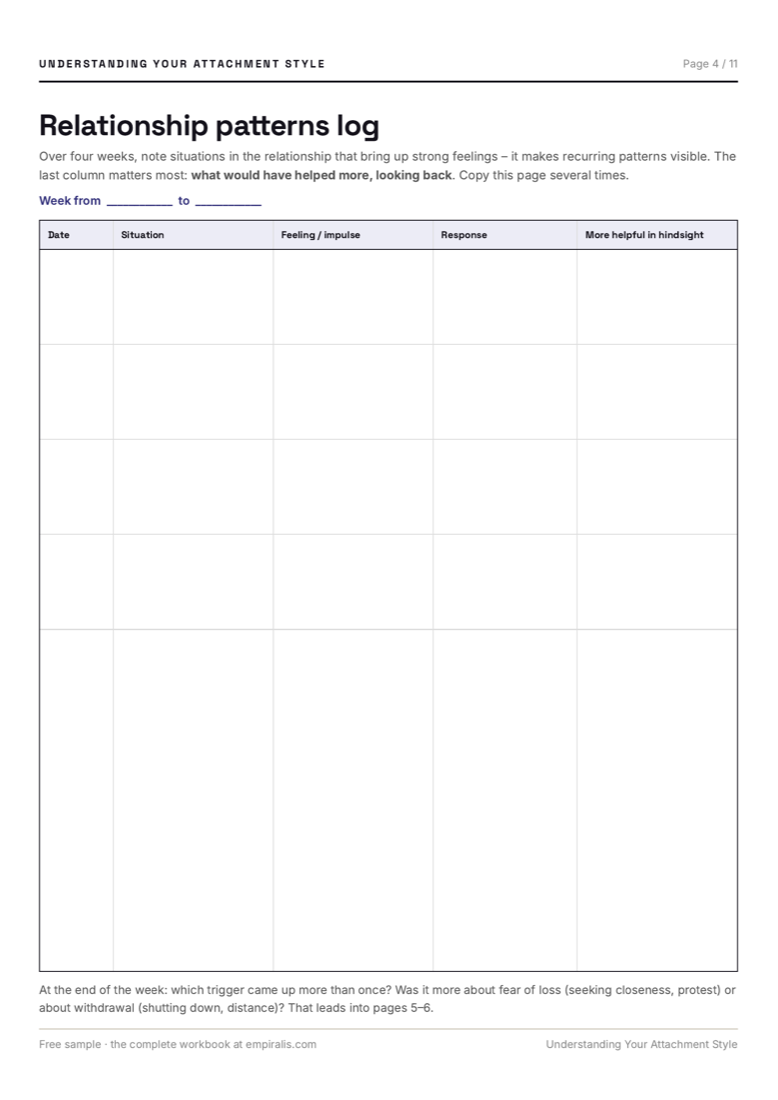
Free preview: Relationship patterns log (page 4)
Enter your email — we'll send a confirmation link. After confirming you go straight to the download. You'll also be subscribed to the Empiralis newsletter (unsubscribe any time).
Scientific basis
- Fraley, R. C., Waller, N. G., & Brennan, K. A. (2000). An item response theory analysis of self-report measures of adult attachment. Journal of Personality and Social Psychology, 78(2), 350–365. — The ECR-R items are made openly available by the original author for research and applied use.
- Brennan, K. A., Clark, C. L., & Shaver, P. R. (1998). Self-report measurement of adult attachment: An integrative overview. In J. A. Simpson & W. S. Rholes (Eds.), Attachment theory and close relationships (pp. 46–76). Guilford Press. — The original ECR, referenced as scientific background to the revised version.
Related on Empiralis